
A Prehistoric Stone Circle on a Mound, an Extensive Landscape Beyond
mid-18th–early 19th century
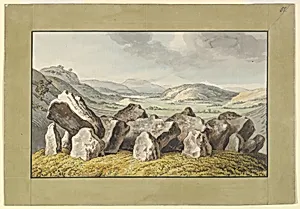
Medium
Black chalk or graphite, pen and brown ink, brush and brown wash, and watercolor; framing lines in pen and black ink
Dimensions
sheet: 7 15/16 x 12 3/4 in. (20.1 x 32.4 cm) mount: 10 13/16 x 15 3/4 in. (27.5 x 40 cm)
Classification
Drawings
Department
Drawings and Prints
Museum
Metropolitan Museum of Art, New York, NY
Credit
Purchase, Didier Aaron Inc. Gift, 2003
Accession Number
2003.99
Rights
Public Domain
Tags
Art Historical Context
In the mid-18th to early 19th century Johann Heinrich Wilhelm Tischbein a member of the prolific German Tischbein family of artists known for their elegant portraits and evocative landscapes, captured the sublime mystery of ancient ruins in *A Prehistoric Stone Circle a Mound, an Landscape Beyond*. This delicate drawing depicts a megalithic stone circle perched a grassy mound, evoking prehistoric monuments like Stonehenge, rolling hills and a vast horizon stretching into the distance. Tischbein's work reflects the Enlightenment-era fascination with archaeology and the Romantic idealization of nature's grandeur, blending human antiquity with the timeless sweep of the British or Northern European countryside. Crafted on a modest sheet measuring 7 15/16 x 12 3/4 inches, the piece masterfully employs mixed media: black chalk or graphite for subtle shading, pen and brown ink for precise contours and framing lines, brush and brown wash for atmospheric depth, and watercolor for soft, luminous tints. These techniques create a textured, almost tactile quality, inviting viewers to ponder the stones' silent history amid the expansive vista. Acquired by The Metropolitan Museum of Art in 2003 through the Purchase, Didier Aaron Inc. Gift, this drawing from the Drawings and Prints department offers a window into how 18th-century artists romanticized prehistory, bridging art and emerging antiquarian scholarship.