
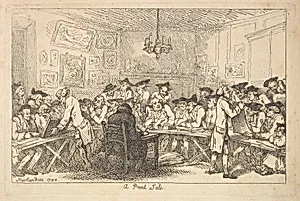
A Print Sale – A Night Auction
Medium
Etching
Dimensions
Plate: 7 3/16 x 10 13/16 in. (18.3 x 27.5 cm) Sheet: 18 1/2 x 12 3/8 in. (47 x 31.5 cm)
Classification
Prints
Department
Drawings and Prints
Museum
Metropolitan Museum of Art, New York, NY
Credit
Harris Brisbane Dick Fund, 1933
Accession Number
33.7(30)
Rights
Public Domain
Tags
Art Historical Context
Thomas Rowlandson’s *A Print Sale – A Night* (1788) captures the vibrant chaos of late 18th London’s art market through a masterful etching. As a leading British caricaturist of the Georgian era, Rowland delighted in satirizing everyday life, often highlighting the absurdities of social gatherings. Here, he depicts a dimly lit auction room teeming with a diverse crowd—buyers, sellers, and folk—vying for affordable prints, a booming commodity that democratized art ownership amid the rising popularity of satire and caricature. Etching, Rowlandson’s preferred medium, allowed him to etch intricate lines into a copper plate with acid, producing rich, tonal effects ideal for conveying bustling energy and expressive faces. The modest plate size (7 3/16 x 10 13/16 in.) made these prints accessible and collectible, mirroring the very scene they portrayed. This work reflects the cultural fervor for print auctions, where nocturnal sales drew night owls eager for bargains on topical images. Housed in the Metropolitan Museum of Art’s Drawings and Prints department, thanks to the Harris Brisbane Dick Fund, this etching offers a window into Regency-era commerce and leisure. It’s a witty reminder of how art itself became a spectacle, blending high culture with the hustle of the streets.
About the Artist
Thomas Rowlandson · 1756–1827
Thomas Rowlandson (1757–1827) was an English artist and caricaturist whose satirical watercolors and prints captured the social life of Georgian Britain with unparalleled wit and technical mastery. Alongside James Gillray, he is recognized as one of the greatest British graphic artists, and his distinctive flowing line and keen observations have made his work integral to understanding late 18th an...