
A River Landscape
Théodore Rousseau, ca. 1845–50
About this artwork
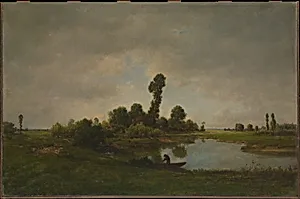
Théodore Rousseau's *A River Landscape* (ca. 1845–) captures the serene beauty of a winding river flanked by lush foliage and distant boats, embodying the artist's deep reverence for nature. A leading figure in the Barbizon School—a group of 19th-century French painters worked en plein air in the Fontainebleau forest—Rousseau rejected the idealized Romantic landscapes of his time. Instead, he pursued a realistic portrayal of the natural world, emphasizing its untamed vitality during the mid-1800s, a period when industrialization was transforming rural France. Painted in oil on wood, a portable medium favored by outdoor artists for its stability and fine surface, this work showcases Rousseau's masterful handling of light and texture. The intimate scale (16 3/8 x 24 7/8 in.) invites viewers into a tranquil scene where dappled sunlight filters through dense trees, highlighting the river's reflective surface and subtle atmospheric effects. This technique foreshadowed Impressionism, influencing later artists like Monet. Now in the Metropolitan Museum of Art's European Paintings collection, thanks to the 1943 bequest of Richard De Wolfe Brixey, *A River Landscape* reminds us of Rousseau's legacy as a pioneer of landscape painting, celebrating the quiet poetry of everyday scenery.