
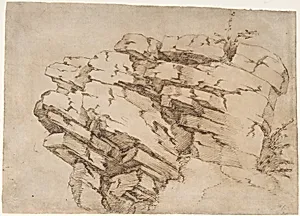
A Rocky Outcrop
1493–1560
Medium
Pen and brown ink
Dimensions
7-1/2 x 10-1/2 in. (19.0 x 26.7 cm)
Classification
Drawings
Department
Drawings and Prints
Museum
Metropolitan Museum of Art, New York, NY
Credit
Harry G. Sperling Fund, 1994
Accession Number
1994.267
Rights
Public Domain
Tags
Art Historical Context
Baccio Bandinelli (1493–1560), a prominent Florentine sculptor draughtsman of the Renaissance, created *A Rocky Outcrop* during a golden age of Italian art. Working in the shadow of masters like Michelangelo—whom he both admired and rivaled—Bandinelli was renowned for his grand sculptures, but his drawings reveal a keen eye for nature's rugged forms. This intimate sheet, executed in pen and brown ink on paper, captures the jagged textures of a mountainous landscape with precise, fluid lines, measuring just 7-1/2 x 10-1/2 inches. The medium of pen and brown ink was ideal for Renaissance draughtsmen, allowing for intricate hatching and contouring to convey volume and light. Bandinelli's study exemplifies the period's fascination with natural observation, often serving as preparatory sketches for larger sculptural projects where rocky terrains provided dramatic backdrops. Its meticulous detail highlights his Mannerist tendencies toward elongated forms and heightened realism, bridging the High Renaissance's harmony with emerging complexities. Today, housed in the Metropolitan Museum of Art's Department of Drawings and Prints (acquired via the Harry G. Sperling Fund in 1994), this work invites visitors to appreciate the foundational role of drawings in monumental art—tiny gems that fueled the era's artistic ambitions.
About the Artist
Baccio Bandinelli · 1493–1560
Bandinelli was the son of Michelangelo de'Brandini, a successful Florentine goldsmith. Baccio was a loyal subject of the Medici, even when they were in exile 1494-1513; consequently he was rewarded by receiving commissions after the elections to the papacy of Leo X (Giovanni de' Medici) and Clement VII (Giulio de' Medici), and after Cosimo de' Medici became Grand Duke of Tuscany in 1537. His polit...