
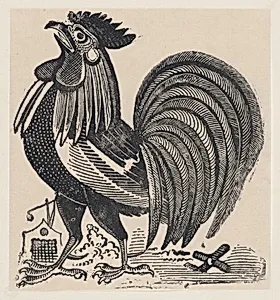
A rooster
ca. 1880–1910
Medium
Zincograph
Dimensions
Sheet: 5 11/16 × 5 5/16 in. (14.5 × 13.5 cm)
Classification
Prints
Department
Drawings and Prints
Museum
Metropolitan Museum of Art, New York, NY
Credit
Gift of Jean Charlot, 1930
Accession Number
30.82.78
Rights
Public Domain
Tags
Art Historical Context
Behold the spirited *A Rooster* by José Guadalupe Posada, a master of Mexican printmaking active from the late 19th to 20th century. around 1880–1910, this zincograph—a relief printing technique using zinc plates for affordable, high-volume reproduction—captures a vigilant rooster in bold, economical lines. Measuring just 5 11/16 × 5 5/16 inches, its compact size belies Posada's larger-than-life influence on popular Mexican art. Posada, often called the father of the modern Mexican graphic arts, produced thousands of prints for newspapers and broadsides during Mexico's turbulent Porfiriato era, blending satire, folklore, and social commentary. While renowned for his iconic calaveras (skeletal figures mocking death and authority), works like this rooster showcase his skill in everyday motifs, evoking rural life and cultural symbols of strength and dawn. Zincography allowed his dynamic, folk-inspired style to reach the masses, paving the way for later muralists like Diego Rivera. Today, this gem from the Metropolitan Museum of Art's Drawings and Prints department—gifted by artist Jean Charlot in 1930—reminds us of Posada's enduring legacy in celebrating Mexico's vibrant visual traditions. Spot the rooster's proud strut and imagine it crowing through history!
About the Artist
José Guadalupe Posada · 1852–1913
José Guadalupe Posada (1852-1913) was a Mexican printmaker and engraver who revolutionized popular art and created some of the most iconic images in Mexican culture. Working primarily with publisher Antonio Vanegas Arroyo, he produced over 20,000 images during his career—inexpensive broadsheets sold for a penny on colored paper that made his art accessible to even the poorest workers. He transform...