
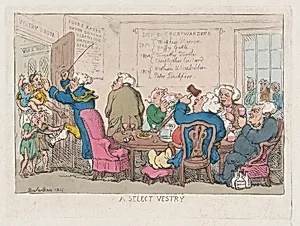
A Select Vestry
April 20, 1806
Medium
Hand-colored etching
Dimensions
Plate: 5 7/16 × 7 5/16 in. (13.8 × 18.5 cm) Sheet (inset): 8 1/4 × 11 5/16 in. (21 × 28.8 cm)
Classification
Prints
Department
Drawings and Prints
Museum
Metropolitan Museum of Art, New York, NY
Credit
The Elisha Whittelsey Collection, The Elisha Whittelsey Fund, 1959
Accession Number
59.533.1871
Rights
Public Domain
Tags
Art Historical Context
Thomas Rowlandson's *A Select Vestry* (1806) is a delightfully biting hand-colored etching that captures the artist's signature satirical flair. Known for his caricatured portrayals of British society, Rowlandson skewers the pretensions and vices of the era with exaggerated figures and lively scenes. Here, a group of men and women indulges in raucous drinking within a church vestry—a room typically reserved for solemn parish meetings—highlighting the hypocrisy of self-appointed church officials. The "select vestry" system, reformed in 1818 amid widespread criticism, empowered small, often corrupt groups to manage local church affairs, making it ripe for Rowlandson's mockery. This print, published amid early 19th-century social commentary, reflects growing public discontent with clerical mismanagement and moral laxity. The hand-coloring technique enhances its appeal, adding vibrant hues to the chaotic composition, a common practice for affordable satirical prints that circulated widely among the middle class. Measuring just over 5 by 7 inches on the plate, this intimate work from The Metropolitan Museum of Art's Elisha Whittelsey Collection exemplifies Rowlandson's mastery of etching for social critique, blending humor with sharp observation to entertain and provoke visitors even today.
About the Artist
Thomas Rowlandson · 1756–1827
Thomas Rowlandson (1757–1827) was an English artist and caricaturist whose satirical watercolors and prints captured the social life of Georgian Britain with unparalleled wit and technical mastery. Alongside James Gillray, he is recognized as one of the greatest British graphic artists, and his distinctive flowing line and keen observations have made his work integral to understanding late 18th an...