
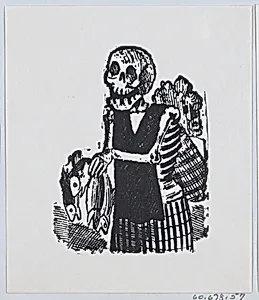
A skeleton selling fish from a broadside entitled 'Una Calavera Chusca'
ca. 1880–1910
Medium
Zincograph
Dimensions
Sheet: 4 1/4 × 3 9/16 in. (10.8 × 9 cm) Image: 3 1/8 × 2 3/8 in. (8 × 6 cm)
Classification
Prints
Department
Drawings and Prints
Museum
Metropolitan Museum of Art, New York, NY
Credit
Gift of Roberto Berdecio, 1960
Accession Number
60.678.57
Rights
Public Domain
Tags
Art Historical Context
In the whimsical yet macabre world of Mexican broadside printing, *A Selling Fish* from theside *Una Calaverausca* (ca 1880–191) captures the satirical genius José Guadalupe Posada, often printed with the assistance of José Sanchez. This tiny zincograph—measuring just 4 1/4 × 3 9/16 inches—depicts a grinning skeleton hawking fish at a market stall, blending everyday commerce with the inevitability of death. Zincography, a zinc-plate lithography technique popular in 19th-century Mexico for affordable mass production, allowed Posada's bold black-line illustrations to proliferate on cheap newsprint, reaching wide audiences. Posada, a pivotal figure in Mexican graphic arts, pioneered the *calavera* (skeleton) motif, which satirized social hypocrisies and poked fun at all classes during Mexico's turbulent Porfiriato era. Here, the fish-seller skeleton embodies the artist's cheeky commentary—*chusca* implying something bawdy or irreverent—reminding viewers that death peddles its wares to everyone, rich or poor. These prints foreshadowed modern Day of the Dead imagery and influenced artists like Diego Rivera. Today, this rare gem, gifted to the Metropolitan Museum of Art in 1960, exemplifies Posada's enduring cultural impact, turning morbid themes into lively folk art that still delights and provokes.
About the Artist
José Guadalupe Posada|José Sanchez · 1852–1913
José Guadalupe Posada (1852-1913) was a Mexican printmaker and engraver who revolutionized popular art and created some of the most iconic images in Mexican culture. Working primarily with publisher Antonio Vanegas Arroyo, he produced over 20,000 images during his career—inexpensive broadsheets sold for a penny on colored paper that made his art accessible to even the poorest workers. He transform...