
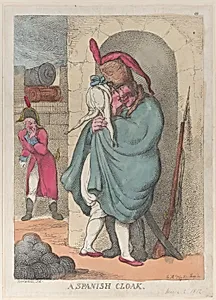
A Spanish Cloak
March 2, 1812
Medium
Hand-colored etching
Dimensions
Sheet: 13 1/2 × 9 5/8 in. (34.3 × 24.5 cm)
Classification
Prints
Department
Drawings and Prints
Museum
Metropolitan Museum of Art, New York, NY
Credit
The Elisha Whittelsey Collection, The Elisha Whittelsey Fund, 1959
Accession Number
59.533.1489
Rights
Public Domain
Tags
Art Historical Context
Thomas Rowlandson, a master of British caricature during the Regency era, created *A Spanish Cloak* in 1812, a hand-colored etching published by Tegg. This lively print, measuring 13½ × 9⅝ inches, captures Rowlandson's signature satirical style—exaggerated figures, witty details, and a touch of bawdy humor. The hand-coloring adds vibrant life to the black-and-white etching, a popular in early 19th-century London print shops, making these affordable satires accessible to a wide audience beyond the elite. Set against the backdrop of the Napoleonic Wars, particularly Britain's Peninsular Campaign in Spain, the artwork pokes fun at soldiers and their romantic escapades. Tags like "Satire," "Soldiers," "Couples," "Men," and "Women" hint at a cheeky scene likely involving amorous encounters under a Spanish cloak—perhaps a soldier's disguise or prop for flirtation. Rowlandson, known for skewering military bravado and social manners, reflects the era's anxieties and amusements amid wartime fervor. Housed in the Metropolitan Museum of Art's Drawings and Prints department (Elisha Whittelsey Collection, 1959), this piece exemplifies the golden age of English caricature. It offers a window into Georgian humor, blending sharp social commentary with playful exaggeration, inviting visitors to chuckle at history's human side.
About the Artist
Thomas Rowlandson|Thomas Tegg · 1756–1827
Thomas Rowlandson (1757–1827) was an English artist and caricaturist whose satirical watercolors and prints captured the social life of Georgian Britain with unparalleled wit and technical mastery. Alongside James Gillray, he is recognized as one of the greatest British graphic artists, and his distinctive flowing line and keen observations have made his work integral to understanding late 18th an...