
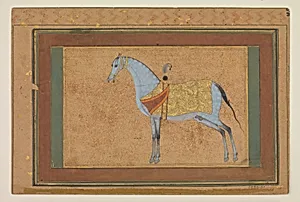
A Stallion
ca. 1601–6
Medium
Ink, opaque watercolor, and gold on paper
Dimensions
Painting: H. 11 7/8 in. (30.1 cm) W. 8 in. (20.3 cm) Page: H. 7 3/4 in. (19.7 cm) W. 5 in. (12.7 cm)
Classification
Codices
Department
Islamic Art
Museum
Metropolitan Museum of Art, New York, NY
Credit
Purchase, Louis E. and Theresa S. Seley Purchase Fund for Islamic Art, The Edward Joseph Gallagher III Memorial Collection, Edward J. Gallagher Jr. Bequest, and Richard S. Perkins and Margaret Mushekian Gifts, 1992
Accession Number
1992.51
Rights
Public Domain
Tags
Art Historical Context
*A Stallion* by Habiballah of Sava created around 1601–6, is a exquisite example of Safavid Persian miniature painting.ed in ink, opaque watercolor, and gold on paper, work measures about 12 by 8 inches for the painting itself. Habiballah, a master from Sava near Qazvin, renowned for his sensitive portrayals of animals, capturing their vitality with remarkable realism. This piece likely originates from a codex or illuminated manuscript, a format central to Islamic art where single pages like this could illustrate poetry, histories, or scientific texts. During the reign of Shah Abbas I, the Safavid dynasty (1501–1722) marked a golden age for Persian painting, blending intricate detail with luminous colors. Opaque watercolors—gouache-like pigments—allowed for bold, jewel-toned hues, while gold heightened the luxurious, otherworldly glow typical of courtly workshops. Horses held profound cultural significance in Persian and Islamic traditions, symbolizing nobility, power, and the swift steeds of epic tales like the *Shahnameh*. Habiballah's stallion, poised with muscular grace, exemplifies the era's mastery of anatomy and movement. Today, housed in the Metropolitan Museum of Art's Islamic Art department, this work invites visitors to marvel at Safavid artistry's enduring elegance, bridging artistry and storytelling across centuries.