
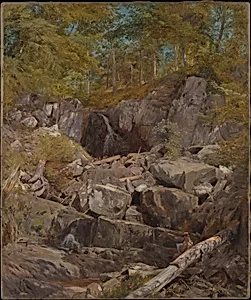
A Study of Trap Rock (Buttermilk Falls)
1863
Medium
Oil on canvas
Dimensions
20 x 24 in. (50.8 x 61 cm)
Classification
Painting
Culture
American
Department
The American Wing
Museum
Metropolitan Museum of Art, New York, NY
Credit
Gift of the artist, 1882
Accession Number
82.9.7
Rights
Public Domain
Tags
Art Historical Context
John Henry Hill's *A Study of Trap RockButtermilk Falls)*, painted in 1863, invites viewers into the rugged beauty of an American natural wonder. This oil on canvas, measuring 20 x 24 inches, captures the dramatic interplay of cascading water and sturdy trap rock formations—dense, columnar basalt typical of volcanic landscapes—at Buttermilk Falls. Hill, an American artist, renders the scene with a keen eye for texture and light, emphasizing the raw power of nature in a style aligned with 19th-century landscape traditions. Created amid the turmoil of the Civil War, the work offers a poignant contrast: a serene, timeless vista amid national strife. Oil on canvas allowed Hill to achieve luminous effects and tactile depth, evoking the movement and mist of waterfalls against unyielding stone. As a "study," it reflects the era's fascination with direct observation from nature, blending scientific precision with artistic wonder. Now housed in the Metropolitan Museum of Art's American Wing, this piece was a generous gift from the artist himself in 1882. It celebrates America's evolving cultural identity through its landscapes, reminding us of the enduring allure of waterfalls and wild terrains that inspired generations of artists and explorers.