
A Summer Landscape
1883
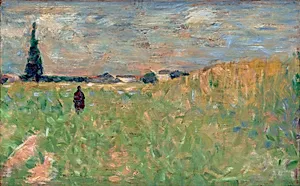
Medium
oil on wood
Dimensions
overall: 15.88 × 25.08 cm (6 1/4 × 9 7/8 in.)
Classification
Painting
Department
CF
Museum
National Gallery of Art, Washington, D.C.
Credit
Collection of Mr. and Mrs. Paul Mellon
Accession Number
2014.18.52
Rights
Public Domain
Art Historical Context
Georges Seurat’s *A Summer Landscape* (1883) offers a glimpse into the artist’s early experimentation with light and color. Painted in oil on a small wooden panel, the work’s intimate scale suggests it may have been created outdoors, capturing the fleeting effects of a summer day. At just over six by nine inches, it reflects the portable nature of such studies, allowing Seurat to work directly from nature. Seurat, a leading figure in the Neo-Impressionist movement, was developing his distinctive approach to color and form around this time. Though best known later for his Pointillist technique of applying tiny dots of pure color, this earlier landscape reveals his growing interest in structured composition and optical mixing. The choice of wood as a support adds a warm, textured ground that subtly influences the painting’s luminosity. Acquired by the National Gallery of Art through the generosity of Mr. and Mrs. Paul Mellon, the piece highlights Seurat’s foundational explorations that would soon transform modern painting. Its modest size invites close viewing, rewarding visitors with an appreciation for the artist’s meticulous observation of the natural world.
About the Artist
Georges Seurat · 1859–1891
Georges Seurat (1859-1891) was the founder of Neo-Impressionism and the inventor of Pointillism, a revolutionary technique that transformed how artists understand and apply color. In a tragically brief career cut short at age 31, Seurat produced only seven monumental paintings, yet his systematic application of color theory fundamentally altered the direction of modern art. Born in Paris to a pro...