
A Sunny Street at Tivoli
1846
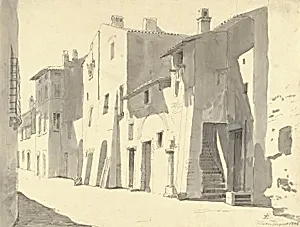
Medium
Pen and black ink, brush and gray wash, over graphite
Dimensions
Sheet: 11 1/4 × 14 13/16 in. (28.6 × 37.6 cm)
Classification
Drawings
Department
Drawings and Prints
Museum
Metropolitan Museum of Art, New York, NY
Credit
The Elisha Whittelsey Collection, The Elisha Whittelsey Fund, 2015
Accession Number
2015.12
Rights
Public Domain
Tags
Art Historical Context
Thorald Læssøe’s *A Sunny Street at Tivoli* (1846) captures the lively bustle of Copenhagen’s famed Tivoli Gardens, an amusement park that opened just three years earlier and quickly became a symbol of modern leisure and national pride during Denmark’s Golden Age. As a Danish artist active in the mid-19th century, Læssøe specialized in detailed architectural and street scenes, blending realism with a touch of romantic light to evoke everyday vibrancy. This drawing, housed in the Metropolitan Museum of Art’s Drawings and Prints department, offers a glimpse into urban life amid Tivoli’s enchanting pathways, where sunlight dances on cobblestones and figures mingle under leafy arches. Executed in pen and black ink with brush and gray wash over graphite on a modest 11¼ × 14⅞-inch sheet, the work showcases Læssøe’s mastery of mixed-media techniques. The graphite underdrawing provides precise structural lines for buildings and figures, while fluid ink contours add definition, and subtle gray washes build tonal depth to mimic dappled sunlight and shadows. This approach, common in preparatory sketches but elevated here to a finished study, highlights the drawing’s role in 19th-century artistic practice—quick yet evocative renderings that preserved fleeting atmospheres without the permanence of oil. Part of The Elisha Whittelsey Collection, this piece underscores Tivoli’s cultural impact as a hub of entertainment and social gathering, reflecting Denmark’s post-Napoleonic era of optimism and national identity. Visitors today can appreciate how Læssøe’s keen eye transforms a simple street into a sunlit memory of 1840s Copenhagen.