
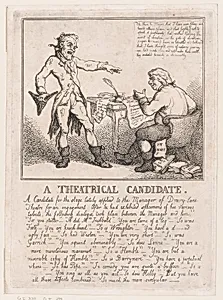
A Theatrical Candidate
Medium
Etching
Dimensions
Sheet: 14 7/16 × 10 1/2 in. (36.6 × 26.6 cm) Plate: 13 7/8 × 9 15/16 in. (35.2 × 25.3 cm)
Classification
Prints
Department
Drawings and Prints
Museum
Metropolitan Museum of Art, New York, NY
Credit
Harris Brisbane Dick Fund, 1917
Accession Number
17.3.888-303
Rights
Public Domain
Tags
Art Historical Context
Thomas Rowlandson's *A Theatrical Candidate* (1797) is a sparkling example of Georgian-era satire, captured in the intricate medium of etching. This British caricaturist, renowned for his lively hand-colored prints that poked fun at society's follies, skewers the world of actors and ambition with his signature wit. The image, measuring about 14 by 10 inches on its sheet, features exaggerated male figures—likely performers posturing dramatically—highlighting the theatrical pretensions of the late 18th century. Created amid Britain's vibrant print culture, where satires like Rowlandson's flew off the presses to critique politics, theater, and social climbers, this work reflects the era's obsession with spectacle. The 1790s saw theaters as stages for both entertainment and subtle political commentary, and Rowlandson's loose, fluid etching lines—bitten into a metal plate with acid—allowed for sharp details and mass reproduction, making his barbs accessible to a wide audience. Etching's versatility suited Rowlandson's dynamic style, blending humor with keen observation. Housed in The Metropolitan Museum of Art's Drawings and Prints department (thanks to the Harris Brisbane Dick Fund of 1917), this print invites us to chuckle at timeless human vanity: the aspiring "candidate" whose performance might just steal the show.
About the Artist
Thomas Rowlandson · 1756–1827
Thomas Rowlandson (1757–1827) was an English artist and caricaturist whose satirical watercolors and prints captured the social life of Georgian Britain with unparalleled wit and technical mastery. Alongside James Gillray, he is recognized as one of the greatest British graphic artists, and his distinctive flowing line and keen observations have made his work integral to understanding late 18th an...