
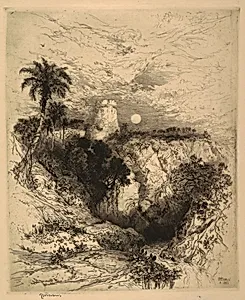
A Tower of Cortez, Mexico
Classification
architecture
Department
Smithsonian Collection
Museum
Smithsonian American Art Museum
Credit
Bequest of Ruth B. Moran
Accession Number
1948-71-3
Rights
Public Domain
About this artwork
Research in Progress
Art Historical Context
Thomas Moran, the renowned American landscape painter born in Britain (18371926), captured the majestic "A Tower of Cortez," in 1883. A key figure in the Hudson River, Moran was celebrated for his luminous depictions of the American West, but this work reflects his adventurous travels abroad. That year, he journeyed to Mexico, sketching historic sites amid the country's colonial legacy, blending Romanticism with precise observation to evoke a sense of timeless grandeur. The title refers to a tower linked to Hernán Cortés, the Spanish conquistador who toppled the Aztec Empire in the 1520s. Classified as architecture, the artwork likely portrays a remnant of Mexico's colonial past—perhaps a fortress or bell tower—symbolizing the clash of cultures and enduring Spanish influence. Moran's style, with its dramatic lighting and atmospheric depth, transforms stone into a poetic monument, highlighting his mastery in conveying history through nature's frame. Bequeathed by Ruth B. Moran and housed in the Smithsonian American Art Museum, this piece invites visitors to ponder exploration's echoes. Though research continues, it stands as a testament to Moran's global vision and America's artistic gaze on the world.