
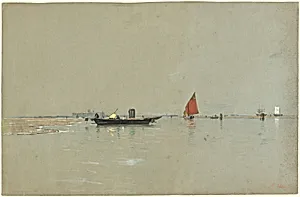
A Venetian Lagoon
1871/1874
Medium
pen and brown ink with watercolor and gouache over graphite, with white heightening, on blue-gray wove paper
Dimensions
sheet: 36.5 × 55.9 cm (14 3/8 × 22 in.)
Classification
Drawing
Department
CG-W
Museum
National Gallery of Art, Washington, D.C.
Credit
Ailsa Mellon Bruce Fund
Accession Number
1968.12.1
Rights
Public Domain
Art Historical Context
William Stanley Haseltine's *A Venetian Lagoon* (1871/1874) captures the serene beauty of Venice's shimmering waterways, a subject that captivated 19th-century American artists traveling abroad. Haseltine, a prominent member of the Hudson River School second generation, was renowned for his luminous landscapes and precise renderings of coastal scenes. This drawing reflects his European sojourns, where he meticulously documented Italy's dramatic light and atmospheric effects, blending Romantic reverence for nature with emerging realist precision. Executed on blue-gray wove paper, the work employs a rich mixed-media technique: graphite underdrawing for initial sketches, pen and brown ink for crisp lines defining boats and distant architecture, layered with translucent watercolor and opaque gouache for vibrant hues. White heightening adds sparkling highlights to the water's surface, evoking the lagoon's ever-shifting reflections under Mediterranean sun. At 36.5 × 55.9 cm, it's an intimate yet expansive study, showcasing Haseltine's mastery in translating ephemeral light onto paper—a hallmark of 19th-century landscape drawing. Acquired through the Ailsa Mellon Bruce Fund for the National Gallery of Art, this piece highlights the era's transatlantic artistic exchange, inviting visitors to ponder Venice's timeless allure through an American lens.
About the Artist
William Stanley Haseltine · 1835–1900
Comment on works: Landscapes