
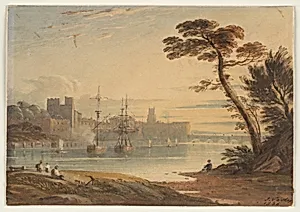
A View of Chester
1836
Medium
Watercolor, reinforced in places with gum, over graphite on card.
Dimensions
125 x 179 mm
Classification
Drawings
Department
Robert Lehman Collection
Museum
Metropolitan Museum of Art, New York, NY
Credit
Robert Lehman Collection, 1975
Accession Number
1975.1.901
Rights
Public Domain
Tags
Art Historical Context
John Varley’s *A View of Chester* (1836) captures the picturesque charm of the historic English city along the River Dee, blending urban architecture with natural landscape elements like boats on the water. As a leading figure in early 19th-century British watercolor painting, Varley was renowned for his atmospheric landscapes that evoke the Romantic era’s reverence for nature and place. This intimate work, measuring just 125 x 179 mm, invites viewers into a serene urban vista, highlighting Chester’s medieval walls and timber-framed buildings against a softly lit sky. Varley employed a meticulous technique: a graphite underdrawing on card provides precise structure, overlaid with translucent watercolor washes reinforced in places with gum arabic. This gum adds luminosity and depth, a hallmark of English watercolor mastery that allowed artists like Varley to rival oil paintings in expressiveness while emphasizing fluidity and light. Popularized in Britain during the Romantic period, watercolors were prized for their portability and suitability for topographical studies. Housed in the Metropolitan Museum of Art’s Robert Lehman Collection since 1975, this drawing exemplifies Varley’s influence on generations of artists, including his pupils J.M.W. Turner and John Linnell. It offers a window into Victorian-era nostalgia for Britain’s ancient cities, blending documentary precision with poetic beauty.