
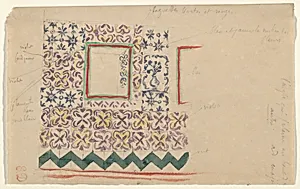
A Wall Decorated in Spanish Tiles
1832
Medium
Watercolor over graphite
Dimensions
Overall: 4 1/2 x 7 1/8 in. (11.4 x 18.1 cm)
Classification
Drawings
Department
Drawings and Prints
Museum
Metropolitan Museum of Art, New York, NY
Credit
Gift from the Karen B. Cohen Collection of Eugène Delacroix, in honor of Dr. Harvey Wolinsky, 2013
Accession Number
2013.1135.16
Rights
Public Domain
Art Historical Context
Eugène Delacroix, leading figure of French Romanticism, created *A Wall Decorated in Tiles* in 1832 as a delicate watercolor over graphite sketch. This intimate study, measuring just 4½ x 7⅛ inches, captures the vibrant patterns of traditional Spanish azulejos—glazed ceramic tiles known for their intricate geometric and floral designs influenced by Moorish artistry. Rendered during Delacroix's travels, it reflects his fascination with exotic architecture and ornamentation, hallmarks of his lifelong interest in Eastern cultures that profoundly shaped his dynamic, color-rich style. The work exemplifies Delacroix's masterful use of mixed media: soft graphite underdrawing provides precise structure, while translucent watercolor layers evoke the luminous play of light on tile surfaces, creating depth and texture in a remarkably small format. Such on-site sketches were vital to his process, serving as direct inspirations for larger oil paintings that infused Romanticism with Orientalist splendor. Today, this gem from the Karen B. Cohen Collection graces the Metropolitan Museum of Art's Drawings and Prints department, a testament to Delacroix's eye for cultural detail and his enduring influence on modern art. Visitors can appreciate how it bridges everyday observation with artistic innovation.
About the Artist
Eugène Delacroix · 1798–1863
Eugène Delacroix (1798–1863) stands as the defining figure of French Romanticism and a pivotal bridge to modernism. Born in Charenton-Saint-Maurice near Paris, he came from distinguished lineage—his mother descended from the prestigious Oeben-Riesener furniture dynasty, while persistent speculation suggested the statesman Talleyrand may have been his biological father, a theory supported by physic...