
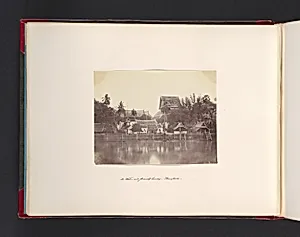
A Wat and Priests Houses, Bangkok
1865
Medium
Albumen silver print from glass negative
Dimensions
16.4 × 22 cm (6 7/16 × 8 11/16 in.)
Classification
Photographs
Department
Photographs
Museum
Metropolitan Museum of Art, New York, NY
Credit
Gilman Collection, Purchase, Cynthia Hazen Polsky Gift, 2005
Accession Number
2005.100.583 (19b)
Rights
Public Domain
Art Historical Context
In 1865, Scottish photographer John Thomson captured *A Wat and Priests, Bangkok* during his pioneering travels through Southeast Asia, just as photography was emerging as a tool for documenting distant cultures. This albumen silver print from a negative offers a rare glimpse into 19th-century Siam (modern-day Thailand), showcasing the serene architecture of a Buddhist wat—a temple complex—and the modest wooden houses of its priests along Bangkok's waterways. Thomson, known for his ethnographic work in China and beyond, ventured into regions few Westerners photographed, blending adventure with artistry to preserve vanishing traditions amid rapid modernization. The medium exemplifies mid-19th-century photographic innovation: glass negatives produced exquisitely detailed images, while the albumen coating—made from egg whites—yielded rich, warm tones and fine gradations that brought architectural textures to life. At 16.4 × 22 cm, this intimate print invites viewers to appreciate the intricate rooftops, gilded spires, and everyday spirituality of Thai monastic life. Housed in The Metropolitan Museum of Art's Gilman Collection, the photograph holds cultural significance as an early visual record of Bangkok's religious landscape, highlighting Buddhism's centrality before Western influences accelerated change. Thomson's unflinching gaze not only documents but humanizes a world on the cusp of transformation, making this a treasured window into Siam's golden age.
About the Artist
John Thomson · 1837–1921
John Thomson (1837–1921), a pioneering Scottish photographer, was born on 14 June 1837 in Edinburgh as the eighth of nine children to William Thomson, a tobacco spinner and trader, and Isabella Newlands.) After schooling in the early 1850s, he apprenticed with a local optical and scientific instrument manufacturer, where he mastered the principles of photography, completing his training around 185...