
A Woman Ironing
1873
Medium
Oil on canvas
Dimensions
21 3/8 x 15 1/2 in. (54.3 x 39.4 cm)
Classification
Paintings
Department
European Paintings
Museum
Metropolitan Museum of Art, New York, NY
Credit
H. O. Havemeyer Collection, Bequest of Mrs. H. O. Havemeyer, 1929
Accession Number
29.100.46
Rights
Public Domain
Tags
Art Historical Context
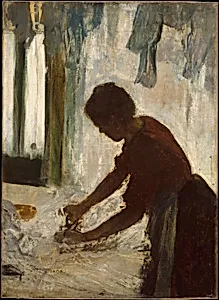
In Edgar Degas' *A Woman Ironing* (1873), an oil on canvas measuring 21⅜ × 15½ inches, we glimpse the quiet intensity of everyday labor. Painted during the early years of Impressionism—a movement Degas helped shape alongside Monet and Renoir—this intimate work captures a working-class woman absorbed in her task, iron in hand. Degas, fascinated by modern urban life, often depicted women in domestic roles, elevating the mundane through his keen observation of posture, gesture, and light. The painting's modest scale and oil medium allowed Degas to experiment with loose, expressive brushwork and unconventional cropping, hallmarks of his realist-inflected Impressionist style. Rather than idealized beauty, he portrayed the physical strain of ironing—bent back, focused gaze—highlighting the dignity and drudgery of 19th-century Parisian working women. This piece reflects broader social shifts, as industrialization drew women into visible labor roles. Now in the Metropolitan Museum of Art's European Paintings department, thanks to the H.O. Havemeyer Collection bequest in 1929, *A Woman Ironing* invites us to appreciate Degas' empathy for the overlooked. A poignant study in human resilience, it reminds visitors of art's power to honor ordinary lives.
About the Artist
Edgar Degas · 1834–1917
Edgar Degas (1834-1917) stands as one of the most innovative artists of the nineteenth century, whose distinctive vision transformed how modern life could be depicted on canvas. Born Hilaire-Germain-Edgar De Gas in Paris to a wealthy banking family—his father French, his mother a Louisiana Creole from New Orleans—Degas received a classical education before abandoning law studies in 1855 to pursue ...