
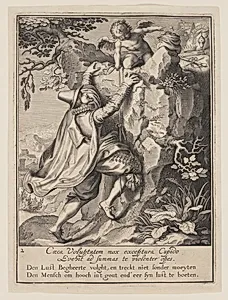
A Young Man Climbing a Hillside Aided by Cupid, from Allegory of the Misuse of Worldly Property
Medium
Engraving on ivory laid paper
Dimensions
Plate: 21.7 × 16 cm (8 9/16 × 6 5/16 in.); sheet: 22.6 × 17 cm (8 15/16 × 6 3/4 in.)
Classification
engraving
Department
Prints and Drawings
Museum
Art Institute of Chicago
Accession Number
268049
Rights
Public Domain
About this artwork
This print series uses symbolic imagery to criticize the love and pursuit of worldly and material goods. A well-to-do man in a white neck ruff is repeatedly tempted by bags of gold presented to him by a blindfolded cupid and a horned demon. In the first print, the Devil sits before an easel, painting the man’s heart with images of women and jewels, while a woman ties a cord around the man’s ankle, binding him to the sin of lust. In the second, Cupid has been transformed from a symbol of pure lov...
Art Historical Context
In the early 17th century, Dutch engraver Willem van Swanburgh crafted *A Young Man Climbing a Hillside Aided by Cup*, a poignant plate from his series *Allegory of theuse of Worldly Property* (1609). This engraving on ivory laid paper captures a moral tale popular in Northern European art: a youthful figure struggles up a steep incline, buoyed by the mischievous Cupid, symbolizing fleeting pleasures and earthly temptations can derail one's path to virtue or true prosperity. Such allegories reflected the era's Protestant emphasis on moral discipline amid the Dutch Republic's rising wealth during the early Golden Age. Swanenburgh's mastery shines in the engraving technique, where he incised fine lines into a metal plate to produce detailed, tonal effects on the delicate 21.7 × 16 cm plate. Ivory laid paper, prized for its smooth texture and subtle chain lines, enhanced the print's clarity and durability, making it ideal for collectors and moral instruction. Housed in the Art Institute of Chicago's Prints and Drawings Department, this work exemplifies how engravings democratized complex iconography, allowing everyday viewers to ponder the pitfalls of worldly excess in an age of economic boom and ethical introspection.