
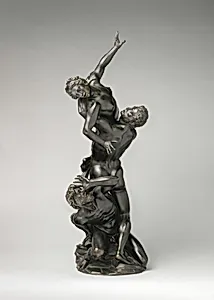
Abduction of a Sabine
18th century
Medium
Bronze
Dimensions
Overall (confirmed): 23 1/4 × 9 1/8 × 10 3/8 in. (59.1 × 23.2 × 26.4 cm)
Classification
Sculpture-Bronze
Culture
Italian, possibly Florence
Department
European Sculpture and Decorative Arts
Museum
Metropolitan Museum of Art, New York, NY
Credit
Gift of Irwin Untermyer, 1970
Accession Number
1970.315
Rights
Public Domain
Tags
Art Historical Context
Behold the dynamic bronze sculpture *Abduction of Sabine* by Giambologna (Jean de Boulogne a masterful 18th-century cast capturing a pivotal moment from Roman legend. In the myth, early Romans, lacking women, abducted brides from the neighboring Sabines during a festival, sparking war but ultimately forging alliances. This scene embodies raw energy and tension, with intertwined nude male and female figures spiraling upward in a dramatic struggle—hallmarks of Giambologna's Mannerist style, developed in late 16th-century Florence where he worked for the Medici court. Crafted in bronze, the 23¼ × 9⅛ × 10⅜-inch sculpture showcases the medium's enduring appeal: its rich patina and ability to convey fluid motion and anatomical precision. Giambologna revolutionized sculpture with his "serpentine" compositions, designed for 360-degree viewing, challenging Renaissance ideals of frontal harmony and inviting viewers to circle the work, discovering new angles of torment and power. A gift to the Metropolitan Museum of Art from Irwin Untermyer in 1970, this Italian treasure from the European Sculpture and Decorative Arts department highlights Florence's legacy of virtuoso bronzes. It invites reflection on themes of conquest, desire, and human form that have captivated audiences for centuries.
About the Artist
Giambologna · 1529–1608
Born and trained in Flanders (Douai, his birthplace, is now in France but was once in Flanders), Giambologna traveled to Italy in 1550 to study Classical and Renaissance sculpture. There, he became court sculptor of the Medici Dukes. He was famed for compositional sophistication, sensuous, tactile treatment of human body, and sheer technical virtuosity. He was extremely influential because the Med...