
Abiud
Unknown Artist
1195–1205
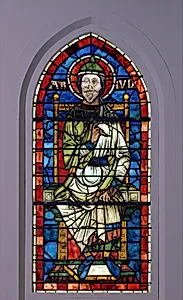
Medium
Pot-metal glass, vitreous paint, and lead
Dimensions
Overall: 76 3/8 x 34 7/8 x 1 1/2 in. (194 x 88.6 x 3.8 cm) Overall (installation opening): 75 1/2 x 34 1/4 in. (191.8 x 87 cm) 47a: 25 11/16 x 34 15/16 in. (65.2 x 88.7 cm) 47b: 24 3/8 x 34 7/8 in. (61.9 x 88.6 cm) 47c: 26 5/16 x 34 11/16 in. (66.8 x 88.1 cm)
Classification
Glass-Stained
Culture
French
Department
Medieval Art
Museum
Metropolitan Museum of Art, New York, NY
Credit
Rogers Fund, 1914
Accession Number
14.47a–c
Rights
Public Domain
Art Historical Context
This stained-glass panel titled *Abiud*, created in France between 1195 and 1205, represents a remarkable survival of medieval craftsmanship. Produced during the height of the Gothic era, when cathedrals across northern France were being filled with luminous windows, the work belongs to a larger narrative series likely illustrating biblical genealogy. Its French origin and placement in the Metropolitan Museum’s Medieval Art collection underscore its role in the spiritual and artistic life of the period, when light itself was seen as a divine symbol. Crafted from pot-metal glass colored while molten, with details added in vitreous paint and joined by lead, the panel demonstrates the technical sophistication of early thirteenth-century glaziers. These materials allowed artists to create bold, jewel-like hues that transformed sunlight into colored patterns inside churches. Though the maker remains unknown, the piece reflects the collaborative workshop tradition of the time, where teams of artisans translated theological stories into visual form for largely illiterate congregations. Acquired by the museum in 1914 through the Rogers Fund, *Abiud* offers today’s visitors a direct connection to the luminous world of medieval worship. Its substantial size and intricate leading reveal how such windows served both as architectural elements and as powerful teaching tools, inviting contemplation of faith, lineage, and the interplay of light and color.