
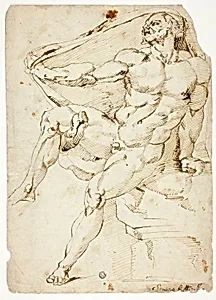
Academic Male Nude Representing Hercules with Nessus's Robe (recto and verso)
Medium
Pen and brown ink, over traces of black chalk (recto and verso), on ivory laid paper
Dimensions
39.8 × 28.4 cm (15 11/16 × 11 3/16 in.)
Classification
pen and ink drawings
Department
Prints and Drawings
Museum
Art Institute of Chicago
Accession Number
112350
Rights
Public Domain
Art Historical Context
Baccio Bandinelli, a prominent Florentine artist of the High Renaissance and early Mannerist period, created this striking double-sided drawing as an academic study of the male nude. Active in the early sixteenth century alongside rivals like Michelangelo, Bandinelli was celebrated for his command of anatomy and dynamic poses, often preparing sculptural projects through such works on paper. The sheet captures Hercules draped in the poisoned robe of Nessus, a mythological episode symbolizing both strength and tragic fate. Executed in pen and brown ink over faint black chalk on ivory laid paper, the drawing exemplifies Renaissance techniques for exploring human form and movement. The recto and verso views allow close examination of musculature from multiple angles, reflecting the era’s emphasis on disegno—the foundational skill of drawing that underpinned both painting and sculpture. Measuring nearly 40 by 28 centimeters, the work’s scale suggests it served as a careful studio exercise rather than a finished presentation piece. Housed in the Art Institute of Chicago’s Prints and Drawings collection, this sheet offers visitors an intimate glimpse into Bandinelli’s working process and the enduring fascination with classical mythology in Renaissance art.
About the Artist
Baccio Bandinelli · 1493–1560
Bandinelli was the son of Michelangelo de'Brandini, a successful Florentine goldsmith. Baccio was a loyal subject of the Medici, even when they were in exile 1494-1513; consequently he was rewarded by receiving commissions after the elections to the papacy of Leo X (Giovanni de' Medici) and Clement VII (Giulio de' Medici), and after Cosimo de' Medici became Grand Duke of Tuscany in 1537. His polit...