
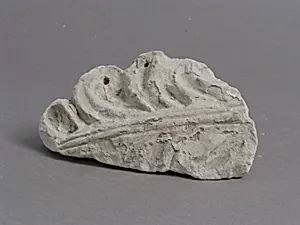
Acanthus Leaf Fragment
Unknown Artist
4th–7th century
Medium
Marble
Dimensions
Overall: 5 3/16 x 4 1/16 x 2 5/16 in. (13.2 x 10.3 x 5.8 cm)
Classification
Sculpture-Stone
Culture
Coptic
Department
Medieval Art
Museum
Metropolitan Museum of Art, New York, NY
Credit
Rogers Fund, 1925
Accession Number
25.10.20.31
Rights
Public Domain
Art Historical Context
This delicate marble fragment, carved in the shape of an acanthus leaf hails from Coptic Egypt during the 4th–7th centuries—a pivotal era when early Christianity flourished amid the remnants of pharaonic and Greco-Roman traditions. Measuring just over 5 inches tall, likely once adorned an architectural element, such as a capital, column, or church screen, in a monastery or basilica. Coptic sculptors masterfully adapted the classical acanthus motif—familiar from ancient Greek Corinthian orders—infusing it with symbolic depth, evoking eternal life and paradise in Christian contexts. Crafted from fine white marble, the piece showcases the precision of Coptic stone carving techniques: deeply incised veins and undulating edges that capture the leaf's natural vigor, achieved through chiseling and polishing. This blend of Hellenistic naturalism and emerging Christian iconography highlights Coptic art's role as a bridge between antiquity and the medieval world, preserving pagan decorative forms while serving new spiritual purposes. Acquired through the Rogers Fund in 1925, this fragment now resides in the Metropolitan Museum of Art's Medieval Art department, offering visitors a tangible link to Egypt's vibrant early Christian heritage. Though small, it whispers of grand sacred spaces lost to time.