
Accessory set
Unknown Artist
early 19th century
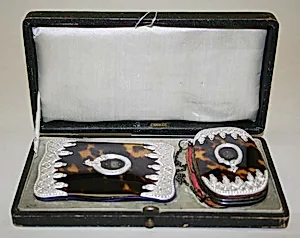
Medium
(a), (b) tortoise shell, metal (c) leather, silk (d) hair, metal
Classification
Accessory Set
Culture
American
Department
Costume Institute
Museum
Metropolitan Museum of Art, New York, NY
Credit
Gift of Mrs. Frederick A. Judson, 1937
Accession Number
C.I.37.54a–d
Rights
Public Domain
Art Historical Context
This exquisite *Accessory Set* from early 19th-century America offers a glimpse into the refined world of fashion during the young republic's formative years. Comprising four pieces—(a) and (b) from tortoise shell and metal, (c) leather and silk, and (d) incorporating human hair and metal—this ensemble likely served as personal adornments such as combs, a reticule, or chatelaines. Donated to the Metropolitan Museum of Art's Costume Institute in 1937 by Mrs. Frederick A. Judson, it reflects the era's blend of practicality and elegance. Tortoise shell, prized for its warm translucency and durability, was a hallmark of luxury accessories, often paired with polished metal for intricate filigree or hinges. The inclusion of silk and leather speaks to the tactile sophistication of women's daily carryalls, while the hair element hints at sentimental mourning jewelry or keepsakes, common in a time when personal mementos held deep emotional value. These materials underscore American craftsmanship influenced by European tastes, as the nation emulated British Regency styles post-Independence. As a cultural artifact, this set illuminates the social rituals of 19th-century American women, where accessories signaled status and taste amid rapid urbanization. Though by an unknown maker, its preservation highlights the Costume Institute's role in safeguarding ephemeral fashion history, inviting us to appreciate the intimate artistry of everyday luxury.