
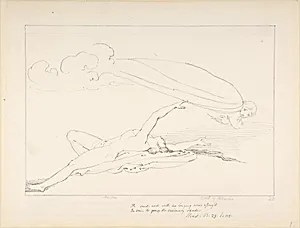
Achilles and the Shade of Patroclus
1793
Medium
Pen and black ink over graphite
Dimensions
Sheet: 8 3/8 x 11 3/8 in. (21.3 x 28.9 cm)
Classification
Drawings
Department
Drawings and Prints
Museum
Metropolitan Museum of Art, New York, NY
Credit
Rogers Fund, 1918
Accession Number
18.132.1
Rights
Public Domain
Tags
Art Historical Context
In the poignant drawing *Achilles and the Shade Patroclus* (1793), British neoclassical artist John Flaxman captures haunting moment from Homer's *Iliad*. Here, the grieving hero Achilles confronts the ghostly shade of his beloved companion Patroclus, who urges him to hold funeral games in his honor. Created with pen and black ink over graphite a modest sheet measuring 8 3/8 x 11 3/8 inches, the work exemplifies Flaxman's linear style—crisp outlines evoking ancient Greek vase paintings, which he admired deeply. Flaxman, a leading figure in late 18th-century neoclassicism, produced these illustrations as part of his influential series for Homer's epics, first published around 1793. The technique of graphite underdrawing refined by bold ink lines allowed for precise, sculptural forms, bridging classical antiquity with Enlightenment ideals of heroism and emotion. Housed in the Metropolitan Museum of Art's Drawings and Prints department (acquired via Rogers Fund, 1918), it highlights the era's revival of Greek mythology amid Romantic sensibilities. This intimate scene underscores the profound homoerotic bond between Achilles and Patroclus, a theme resonant in Western art. Flaxman's economical yet evocative draftsmanship invites viewers to ponder loss, loyalty, and the afterlife, making it a timeless gem for epic enthusiasts.
About the Artist
John Flaxman · 1755–1826
John Flaxman (1755–1826) was born in York, England, the son of John Flaxman Sr., a moulder and seller of plaster casts who ran a studio in London's Covent Garden. Largely self-taught amid his father's stock of classical casts, with minimal formal schooling due to childhood illness, Flaxman displayed prodigious talent early on. At age 12, he won a Society of Arts prize for a medallion; by 15, anoth...