
Acorn-top spoon
Unknown Artist
second half 16th century
Medium
Wood, silver
Dimensions
Overall: 1 15/16 × 6 1/2 in. (4.9 × 16.5 cm)
Classification
Metalwork-Silver In Combination
Culture
German or Dutch
Department
European Sculpture and Decorative Arts
Museum
Metropolitan Museum of Art, New York, NY
Credit
Gift of Mrs. Samuel P. Avery, 1897
Accession Number
97.2.139
Rights
Public Domain
Tags
Art Historical Context
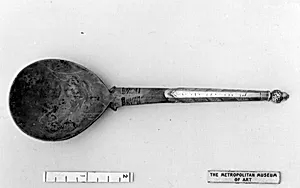
Nestled in the Metropolitan Museum of Art's European Sculpture and Decorative Arts, this charming *Acorn-top spoon* to the second half of 16th century and hails from German or Dutch craftsmanship. Crafted from wood with silver accents, it measures a dainty 1 15/16 × 6 1/2 inches (4.9 × 16.5 cm). The handle culminates in a finely detailed silver acorn finial, blending organic naturalism with precious metalwork—a hallmark of Renaissance-era decorative arts. In the late 16th century, Northern European artisans elevated everyday utensils like spoons into objects of beauty and status. Classified as "Metalwork-Silver in Combination," this piece exemplifies the innovative fusion of humble wood with gleaming silver, showcasing advanced carving and silversmithing techniques. Acorns, evoking the natural world, were popular motifs symbolizing growth and resilience, reflecting the era's fascination with botanic realism amid the Renaissance revival of classical forms. A generous gift from Mrs. Samuel P. Avery in 1897, this spoon offers a glimpse into domestic life among the prosperous classes. Though by an unknown artist, its exquisite detailing invites us to appreciate the unsung skill of period craftsmen, turning the functional into the artistic.