
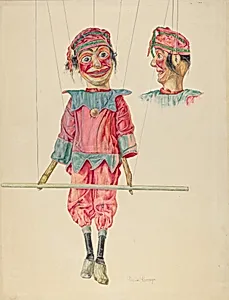
Acrobat Albert
c. 1936
Medium
watercolor and graphite on paperboard
Dimensions
overall: 23.2 x 40.2 cm (9 1/8 x 15 13/16 in.) Original IAD Object: 26" high
Classification
Index of American Design
Department
CG-W
Museum
National Gallery of Art, Washington, D.C.
Credit
Index of American Design
Accession Number
1943.8.16867
Rights
Public Domain
Art Historical Context
**Acrobat Albert** is a captivating watercolor and graphite rendering by artist David Ramage, created 1936. This work a whimsical folk art carving of an acrobat figure, originally standing 26 inches tall. Ramage's precise drawing captures the lively pose and character of the wooden sculpture, highlighting the charm of American vernacular art from the early 20th century. 23.2 x 40.2 cm, the piece invites viewers to appreciate the playful spirit of roadside attractions and carnival figures that dotted the American landscape during the interwar period. As part of the **Index of American Design** (IAD), a groundbreaking Federal Art Project under the Works Progress Administration (WPA) from 1935 to 1942, this artwork holds significant historical value. The IAD employed artists like Ramage to document everyday American crafts, folk objects, and designs through detailed, full-color renderings—preserving cultural heritage amid the Great Depression. Housed in the National Gallery of Art's collection, it exemplifies how these Depression-era efforts celebrated regional artistry and democratic creativity. Ramage's use of watercolor and graphite on paperboard allowed for vibrant hues and fine lines, faithfully reproducing textures and details impossible to capture in photographs alone. This technique not only elevated folk art to museum-worthy status but also educated the public on America's diverse artistic traditions, making **Acrobat Albert** a delightful window into our shared past.