
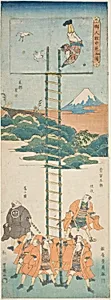
Acrobats on a Ladder
18th-19th century
Medium
Color woodblock print; hosoban
Classification
woodblock print
Department
Arts of Asia
Museum
Art Institute of Chicago
Accession Number
20266
Rights
Public Domain
Art Historical Context
In the vibrant world of-period Japan (1603–1868), Utagawa Toyokuni (1769–1825) captured the thrill of street performances in *Acrobats on a Ladder*, a color woodblock print from the 18th to early 19th century. As a master of the Uawa school and ukiyo-e ("pictures of the floating world"), Toyokuni specialized in dynamic yakusha-e prints of kabuki actors, but here he turns to acrobats—itinerant entertainers who dazzled urban crowds with daring feats. The narrow hosoban format (roughly 7 x 13 inches) suggests it was designed for intimate viewing, perhaps as part of a diptych or personal collection. This woodblock print exemplifies ukiyo-e's technical brilliance: artisans carved intricate designs into cherry wood blocks, layering vibrant colors through precise inking and printing. Toyokuni's bold lines and expressive poses convey motion and tension, with the acrobats' precarious balance evoking the ephemerality of life's pleasures—a core ukiyo-e theme. Housed in the Art Institute of Chicago's Arts of Asia department, *Acrobats on a Ladder* offers a window into Japan's thriving popular culture, where such performers bridged theater and everyday spectacle. It reminds us how art democratized entertainment, making high-wire drama accessible to all.
About the Artist
Utagawa Toyokuni I · 1777–1835
Japanese, 1777–1835