
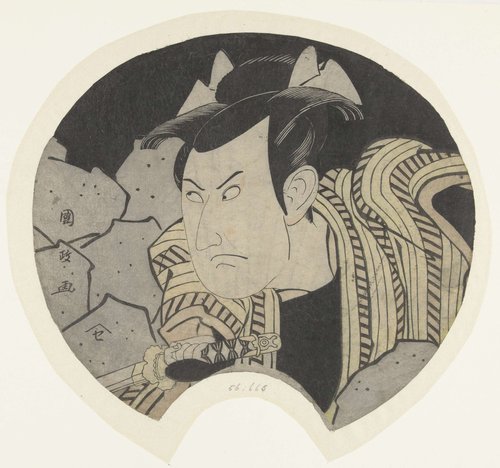
Acteur met zwaard
1795 - 1800
Medium
color woodcut
Dimensions
258; 198
Rights
Public Domain
About this artwork
kleurenhoutsnede; lijnblok in zwart met kleurblokken
Art Historical Context
"Acteur met Zwaard" (Actor with Sword), created by Utagawa Kunasa around 1795-1800, captures the dramatic flair of kabuki theater in Edo-period Japan. Kunimasa, a master of the Utagawa school, specialized in yakusha-e—vibrant portraits of actors in dynamic poses. This color woodcut likely depicts a famous performer mid-scene, sword in hand, embodying the intense emotion and stylized movement central to kabuki's all-male casts. At 198 x 258 mm, it's a compact chûban print, perfectly sized for affordable distribution among theater enthusiasts. The artwork showcases the pinnacle of ukiyo-e woodblock printing, known as nishiki-e or "brocade pictures." Kunimasa's design began with a key block carved in black for precise outlines, followed by multiple color blocks layered to achieve rich hues— a labor-intensive process involving skilled carvers, printers, and publishers. This technique allowed mass production, making art accessible beyond the elite. Culturally, such prints were more than decoration; they advertised performances, immortalized stars, and fueled Japan's "floating world" of entertainment. Today, "Acteur met Zwaard" offers a window into 18th-century Tokyo's vibrant street life, where theater and visual spectacle intertwined.
About the Artist
Utagawa Kunimasa · 1773–1810
Utagawa Kunimasa (1773–1810) was a Japanese ukiyo-e artist specializing in yakusha-e, or Kabuki actor prints, during the late Edo period. Born in Aizu, Fukushima Prefecture in 1773, Kunimasa initially worked in a local dye factory for several years before pursuing his true passion. As an ardent Kabuki theatre enthusiast, he relocated to Edo (modern Tokyo) to establish himself as an artist capable ...