
Ad Astra
1894–96
Medium
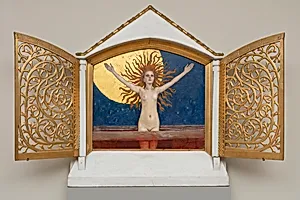
Oil on canvas, in artist's painted and gilded wood shrine
Dimensions
Canvas: 76 × 85 cm (29 15/16 × 33 7/16 in.); Framed: 129.6 × 116.9 × 14.7 cm (51 1/16 × 46 1/16 × 5 13/16 in.)
Classification
oil on canvas
Department
Painting and Sculpture of Europe
Museum
Art Institute of Chicago
Accession Number
234877
Rights
Public Domain
About this artwork
After associating with the Symbolists, including Edvard Munch, in Paris, Akseli Gallen-Kallela carried these influences to his native Finland while also incorporating indigenous folkloric traditions into his artistic practice. By intermingling Nordic Neo-Romanticism, Symbolism, and the decorative arts, he created a new visual language, which both spoke to and espoused the burgeoning sense of Finnish identity in the late 19th century. This conception of a unique ethnic culture reflected a general...
Art Historical Context
**Ad Astra** (1894–96) by Finnish artist Akseli Gallen-Kalle captures a moment of transcendent aspiration, its title translating from Latin as "to the stars." during Finland's National Romantic era, when artists drew inspiration from folklore and mythology amid growing calls for independence from Russian rule, this oil on canvas reflects Gallen-Kallela mastery of Symbolism. His style blends ethereal mysticism with bold, decorative forms influenced by Art Nouveau, evoking the soul's journey toward the infinite. What sets **Ad Astra** apart is its presentation: the canvas is housed in a custom painted and gilded wood shrine crafted by the artist himself, transforming the work into a sacred object akin to a medieval altarpiece. This integral frame, measuring over 129 cm tall, amplifies the painting's spiritual aura, drawing viewers into a private realm of contemplation. At 76 × 85 cm, the luminous composition invites reflection on human longing and the cosmos. Housed in the Art Institute of Chicago's Department of Painting and Sculpture of Europe, **Ad Astra** exemplifies Gallen-Kallela's role in elevating Finnish art on the international stage during the late 19th century, blending technical virtuosity with profound cultural symbolism.