
Adam and Eve
Albrecht Dürer, 1504
About this artwork
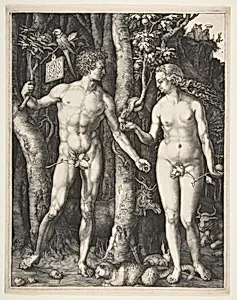
Albrecht Dürer's *Adam and Eve* (1504) is a pinnacle of Northern Renaissance printmaking, now housed in the Metropolitan Museum Art's Drawings and Prints. This intimate engraving, measuring just 9 7/8 x 7 7/8 inches, captures the figures in the Garden of Eden moments before the Fall. Adam stands poised with muscular idealization drawn from classical antiquity, while Eve reaches toward the forbidden fruit, surrounded by a menagerie of creatures—birds, cats, rabbits, snakes oxen, and more—that evoke the paradise's harmony and latent temptation. Dürer, a German artist who bridged Italian Renaissance humanism with Northern precision, drew on his studies of human anatomy and nature to craft figures of unprecedented realism and proportion. The animals likely symbolize the four classical humors—phlegmatic ox, sanguine rabbit, choleric cat, and melancholic elk (implied among the fauna)—reflecting Renaissance fascination with balance in body and soul. Created amid Dürer's travels to Venice, it showcases his mastery in blending symbolism with scientific observation. As an engraving, the work's significance lies in its technical brilliance: Dürer's burin etched intricate lines into copper, allowing thousands of impressions and democratizing high art. Acquired via the Fletcher Fund in 1919, it remains a testament to how prints revolutionized visual culture in the early 16th century, inviting viewers to ponder humanity's primal innocence.