
Adam and Eve
1504
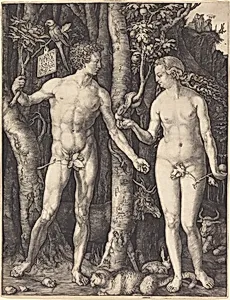
Medium
engraving on laid paper
Dimensions
sheet (trimmed to plate): 25.3 × 19.6 cm (9 15/16 × 7 11/16 in.)
Classification
Department
CG-E
Museum
National Gallery of Art, Washington, D.C.
Credit
Rosenwald Collection
Accession Number
1943.3.3491
Rights
Public Domain
Art Historical Context
Albrecht Dürer's *Adam and Eve* (1504) is a masterpiece of Northern Renaissance printmaking, capturing the biblical moment before the Fall in the Garden of Eden. Created Dürer's mature period, after his influential travels to Italy, the engraving reflects his fascination with classical anatomy and ideal human proportions, blending German precision with Italian Renaissance humanism. The nude figures stand poised amid a lush, detailed landscape teeming with over 100 plant species and animals, symbolizing harmony with nature. As an engraving on laid paper, measuring about 25 x 20 cm, this work showcases Dürer's unparalleled technical virtuosity. He meticulously incised fine lines into a copper plate, achieving extraordinary depth, texture, and tonal subtlety—hallmarks of his "Meisterstich" (master engraving) series. Prints like this were revolutionary, allowing affordable dissemination of high art to collectors across Europe, elevating engraving from craft to fine art. Housed in the National Gallery of Art's Rosenwald Collection, *Adam and Eve* remains culturally iconic, embodying Renaissance curiosity about the body, morality, and the natural world. Its intricate details reward close viewing, inviting visitors to ponder humanity's primal innocence.
About the Artist
Albrecht Dürer · 1471–1528
Albrecht Dürer (1471–1528) stands as the preeminent figure of the Northern Renaissance and arguably the most influential artist in the history of printmaking. Born in Nuremberg on May 21, 1471, and dying in the same city on April 6, 1528, Dürer revolutionized the status of the artist in Northern Europe, transforming printmaking from a commercial craft into an independent fine art and establishing ...