
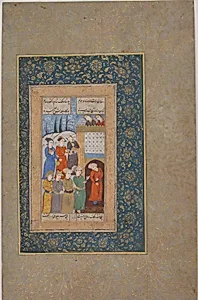
Adam and Four Prophets
Unknown Artist
17th century
Medium
Ink, opaque watercolor, and gold on paper
Dimensions
H. 5 1/8 in. (13 cm) W. 2 5/8 in. (6.7 cm)
Classification
Codices
Department
Islamic Art
Museum
Metropolitan Museum of Art, New York, NY
Credit
Bequest of George D. Pratt, 1935
Accession Number
45.174.15
Rights
Public Domain
Tags
Art Historical Context
Nestled within the Islamic Art collection at the Metropolitan Museum of Art, *Adam and Four Prophets* is a delicate 17th-century page from a codex, measuring just 5⅛ × 2⅝ inches. Crafted by an unknown artist using ink, opaque watercolor, and gold on paper, this miniature exemplifies the exquisite illumination techniques of Persianate manuscript traditions. The small scale invited intimate contemplation, often by scholars or elites, while the lavish gold accents and vibrant gouache-like watercolors brought sacred narratives to life with luminous depth and jewel-toned hues. Depicting Adam alongside four prophets—figures central to Islamic theology—this artwork reflects the Quran's emphasis on prophetic lineages and divine revelation. Produced during the Safavid era or similar regional schools, such codices blended calligraphy, illustration, and decoration in luxurious volumes, serving both devotional and artistic purposes. The inclusion of female figures, hinted at in its metadata, may evoke broader storytelling elements from religious texts, underscoring the genre's narrative richness. Bequeathed by George D. Pratt in 1935, this gem highlights the technical mastery of Islamic miniaturists: precise ink outlines, layered opaques for texture, and gold for ethereal glow. It invites visitors to marvel at how portable piety illuminated the spiritual world of the 17th century.