
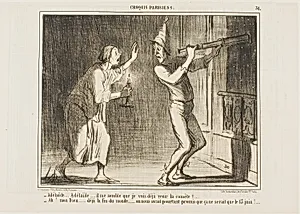
“- Adelaide, Adelaide.. I think I can see the comet coming!!... - Oh my God... this is the end of the world.... how annoying. They promised it wouldn't come until June 13!,” plate 31 from Croquis Parisiens
February 18, 1857
Medium
Lithograph in black on ivory wove paper
Dimensions
Image: 20.4 × 25.9 cm (8 1/16 × 10 1/4 in.); Sheet: 25.2 × 36 cm (9 15/16 × 14 3/16 in.)
Classification
lithograph
Department
Prints and Drawings
Museum
Art Institute of Chicago
Accession Number
3400
Rights
Public Domain
About this artwork
After the Comet of Charles V failed to reappear in the 1840s, as astronomers predicted, a Belgian almanac writer announced that it would arrive on June 13, 1857, when it would collide with the earth and end all life. The prediction spread across Europe, but its effect was particularly pronounced in Paris, where terrified families began to prepare for the end. The situation was ripe for mockery, and it also enabled Daumier to compose a variety of night scenes, which he particularly enjoyed drawin...
Art Historical Context
Honoré Daumier, a master of 19th-century French satire, captures the absurdities of Parisian life in thisograph from his *Croquis Parisiens*. Published on February 18, 1857, plate 31 a comically panicked couple—likely a bourgeois pair—gazing skyward as the husband exclaims about an impending comet, only for his wife to lament its untimely arrival before June 13. Titled “- Adelaide, Adelaide.. think I can see the coming!!... - Oh my God... this is the end of the world.... how annoying. They promised it wouldn't come until June 13!,” the work skewers apocalyptic hysteria and petty complaints amid perceived doom. Daumier, a pioneer of Realism in caricature, used his prints to critique society under Napoleon III's Second Empire. Comets often sparked millenarian fears in the era, evoking historical events like the 1835 panic, but here he transforms dread into farce, highlighting human folly. This piece reflects the vibrant street press culture, where such images reached wide audiences, influencing public opinion through humor. Printed in black ink on ivory wove paper (image 20.4 × 25.9 cm), lithography allowed Daumier's expressive lines and dynamic shading to mimic drawing's spontaneity while enabling affordable reproduction. Housed in the Art Institute of Chicago's Prints and Drawings department, it exemplifies how this medium democratized art and satire.
About the Artist
Honoré-Victorin Daumier · 1808–1879
Honoré-Victorin Daumier (1808-1879) was a prolific French printmaker, caricaturist, painter, and sculptor whose works offered incisive commentary on the social and political life of 19th-century France. Known as the 'Michelangelo of Caricature,' Daumier produced over 4,000 lithographs, 500 paintings, 1,000 drawings, and 100 sculptures during his lifetime. His biting political satire led to his imp...