
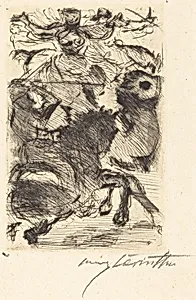
Adhba die Kamelin (Adhba the Camel)
1919
Medium
drypoint in black on wove paper
Dimensions
plate: 13.3 x 8.7 cm (5 1/4 x 3 7/16 in.) sheet: 23.2 x 14.4 cm (9 1/8 x 5 11/16 in.)
Classification
Department
CG-W
Museum
National Gallery of Art, Washington, D.C.
Credit
Gift of the Marcy Family in memory of Sigbert H. Marcy
Accession Number
1991.243.5
Rights
Public Domain
Art Historical Context
**Adhba die Kamelin (Adhba the Camel)** Lovis Corinth (1858–1925), a leading German artist known for his bold transition from Impressionism to Expression, created this intimate drypoint print in 9. The work captures Adhba, a racing camel once owned by Kaiser Wilhelm II, rendered with Corinth's characteristic vigor and emotional intensity. Produced in the turbulent aftermath of World War I, reflects the artist's late-career fascination with animals and exotic subjects, blending whimsy with his expressive style amid personal health struggles from strokes. Drypoint, Corinth's favored printmaking technique here, involves scratching directly into a copper plate with a sharp tool, raising a soft burr that yields rich, velvety black lines on wove paper. This small plate (13.3 x 8.7 cm) invites close viewing, showcasing the textured fur and alert gaze of the camel in a way that highlights the medium's spontaneity and painterly quality—distinct from the precision of etching. A gift to the National Gallery of Art from the Marcy Family in memory of Sigbert H. Marcy, this print exemplifies Corinth's mastery of graphic arts and offers a delightful glimpse into early 20th-century German culture, where imperial extravagance met modern artistic innovation.
About the Artist
Lovis Corinth · 1858–1925
Lovis Corinth, born Franz Heinrich Louis on July 21, 1858, in Tapiau, East Prussia (now Gvardeysk, Russia), to a tanner father, displayed prodigious drawing talent from childhood. He began formal training at the Königsberg Academy in 1876, then moved to the Academy of Fine Arts in Munich from 1880 to 1884, studying under Ludwig von Löfftz and briefly Franz von Defregger, where he absorbed a Realis...