
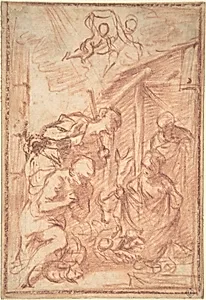
Adoration of the Shepherds
Medium
Red chalk on off-white paper. Composition outlined in ruled red chalk lines.
Dimensions
6-7/8 x 4-3/4 in. (17.5 x 12.1 cm)
Classification
Drawings
Department
Drawings and Prints
Museum
Metropolitan Museum of Art, New York, NY
Credit
Bequest of Harry G. Sperling, 1971
Accession Number
1975.131.228
Rights
Public Domain
Tags
Art Historical Context
Francisco Vieira de Mattos, known as Il Lusitano, was a prominent Portuguese artist of the late Baroque period, active in Rome and Lisbon during the 18th century. His *Adoration of the Shepherd* (ca. 1699–1783) captures a timeless biblical scene from the Nativity, depicting humble shepherds revering the Christ child in the manger—a motif rich in Christian iconography symbolizing humility and divine revelation. This intimate drawing reflects the devotional art popular in Catholic Europe, blending emotional tenderness with dramatic light and shadow typical of Vieira's style. Executed in red chalk on off-white paper, the work measures a modest 6-7/8 x 4-3/4 inches, with its composition precisely outlined by ruled red chalk lines—a technique that underscores the artist's meticulous preparatory process, likely for a larger painting or altarpiece. Red chalk, favored by masters like Rubens and Leonardo, allowed for subtle modeling of forms and warm tonal gradations, lending a lifelike immediacy to the figures' gestures and expressions. Housed in the Metropolitan Museum of Art's Department of Drawings and Prints through the bequest of Harry G. Sperling in 1971, this gem offers visitors a window into 18th-century draftsmanship. It highlights how such sketches bridged studio practice and public devotion, preserving Vieira's legacy as a bridge between Portuguese and Italian artistic traditions.