
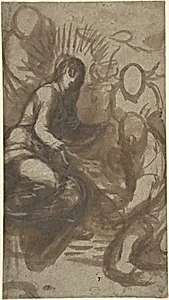
Adoration of the Shepherds(?)
16th century
Medium
Brush and brown wash, highlighted with brush and white gouache, over traces of charcoal underdrawings, on light brown laid paper
Dimensions
12 x 6-5/8 in. (30.5 x 16.8 cm)
Classification
Drawings
Department
Drawings and Prints
Museum
Metropolitan Museum of Art, New York, NY
Credit
Rogers Fund, 1912
Accession Number
12.56.8
Rights
Public Domain
Tags
Art Historical Context
This delicate 16th-century Italian drawing, tentatively titled *Adoration of the Shepherds*, captures a tender biblical scene from the Nativity story, where humble shepherds pay homage to the infant Christ. Created by an anonymous artist during the Renaissance era, it exemplifies the period's devotion to religious themes, blending spiritual narrative with emerging naturalism. Housed in the Metropolitan Museum of Art's Drawings and Prints department (Rogers Fund, 1912), the work measures a modest 12 x 6-5/8 inches, inviting close contemplation of its intricate details. Executed on light brown laid paper—a common support for preparatory sketches—the artist began with faint charcoal underdrawings, then layered brush and brown wash for soft tonal modeling, and highlighted with white gouache for luminous accents. This mixed-media technique, popular among Italian draftsmen like those in Raphael's or Correggio's circles, allowed for rapid yet expressive studies, possibly for a larger painting or altarpiece. The brown wash evokes shadowy stable light, while white highlights dramatize figures' faces and drapery, showcasing masterful control of light and form. Such anonymous sheets offer a window into Renaissance workshop practices, where drawings served as vital tools for composition and training. Though unattributed, its refined execution highlights Italy's enduring legacy in devotional art, reminding visitors of the era's profound fusion of faith, humanism, and technical innovation.