
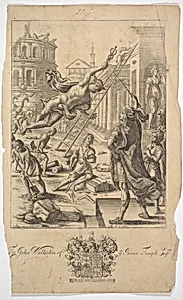
Aeneas and Mercury (from "The Works of Virgil: Containing his Pastorals, Georgics and Aeneis," 1697)
Medium
Etching and engraving; fifth state of five, the plate reduced, as published in 1697 or 1698
Dimensions
Plate: 10 1/4 × 7 11/16 in. (26 × 19.5 cm) Sheet: 13 7/8 × 7 7/8 in. (35.2 × 20 cm)
Classification
Prints
Department
Drawings and Prints
Museum
Metropolitan Museum of Art, New York, NY
Credit
The Elisha Whittelsey Collection, The Elisha Whittelsey Fund, 1963
Accession Number
63.601.13
Rights
Public Domain
Tags
Art Historical Context
This etching and engraving captures a pivotal moment from Virgil’s *Aeneid*, in which the god Mercury appears to the Trojan hero Aeneas. Created by designer Franz Cleyn and master etcher Wenceslaus Hollar, the print was prepared in 1654 and later published in John Dryden’s 1697 English edition of Virgil’s complete works. The scene unfolds among crumbling ruins, ladders, and architectural fragments, evoking both the fall of Troy and Aeneas’s destined journey toward founding Rome. Hollar’s refined technique—combining delicate etching lines with engraved detail—allowed for the crisp reproduction of classical architecture and expressive figures, making the image ideal for a lavishly illustrated book. The plate’s fifth and final state shows it reduced in size for this later publication, reflecting the practical demands of 17th-century printmaking while preserving the dramatic encounter between mortal and divine realms. Acquired by the Metropolitan Museum through the Elisha Whittelsey Fund, the print exemplifies how Baroque-era illustrators brought ancient epic poetry to new English-speaking audiences, blending scholarly reverence for Virgil with the era’s taste for theatrical, ruin-strewn landscapes.
About the Artist
Wenceslaus Hollar|Franz Cleyn|Virgil · 1607–1677
Wenceslaus Hollar (1607-1677) was a prolific Bohemian etcher who became one of the most accomplished printmakers of the seventeenth century. Born in Prague, he trained under Matthäus Merian in Frankfurt before entering the service of Thomas Howard, Earl of Arundel, in 1636. Hollar spent most of his career in England, where he produced approximately 2,740 etchings documenting an extraordinary range...