
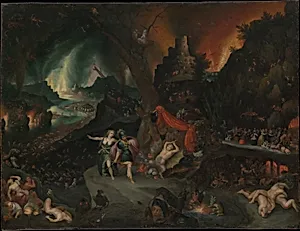
Aeneas and the Sibyl in the Underworld
Medium
Oil on copper
Dimensions
10 1/2 x 14 1/8 in. (26.7 x 35.9 cm)
Classification
Paintings
Department
European Paintings
Museum
Metropolitan Museum of Art, New York, NY
Credit
Gift of Mrs. Erna S. Blade, in memory of her uncle, Sigmund Herrmann, 1991
Accession Number
1991.444
Rights
Public Domain
Tags
About this artwork
Jan Brueghel the Younger's "Aeneas and the Sibyl in the Underworld" (1630s) presents a phantasmagorical vision of classical mythology filtered through Flemish Baroque sensibility. Painted in oil on copper—a support favored for small, jewel-like works with luminous surfaces—this painting depicts the hero Aeneas guided by the Cumaean Sibyl through Hades, a scene from Virgil's Aeneid where Aeneas visits the underworld to consult his deceased father about Rome's future. The infernal landscape draws ...
Art Historical Context
Step into the shadowy depths of classical mythology with Jan Brueghel the Younger's *Aeneas and the Sibyl the Underworld* (1630s), a captivating oil on copper painting now housed in the Metropolitan Museum Art's European Paintings collection This small-scale gem, measuring just 10½ × 14⅛ inches, draws from Virgil's *Aeneid*, where the hero Aeneas, guided by the Cumaeanyl, journeys through Hades to seek prophecies about Rome's destiny from his late father. Brueghel the Younger1601–1678), heir to his father's renowned Antwerp workshop, infuses the scene with Flemish Baroque flair—blending learned classicism, moral allegory, and playful fantasy. The choice of copper as a support creates a luminous, jewel-like surface ideal for intricate details, revealing tormented souls, bizarre architecture, and eerie supernatural glows upon close inspection. Echoing his father Jan Brueghel the Elder and ultimately Hieronymus Bosch's hellish visions, this work traces a rich Flemish lineage of transforming nightmarish underworlds into visually thrilling narratives. Nudes of Aeneas, the Sibyl, and damned figures heighten its dramatic intensity. A gift to the Met in 1991, this piece exemplifies Northern Baroque's enduring love for entertaining yet instructive art, inviting visitors to ponder antiquity's echoes in early modern Europe.