
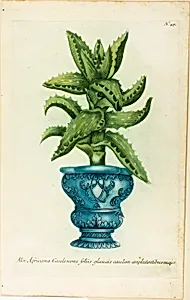
African Aloe, plate 47 from Phtanthoza Iconographia
Medium
Color mezzotint and engraving on cream laid paper
Dimensions
Plate: 32.4 × 21 cm (12 13/16 × 8 5/16 in.); Sheet: 37.5 × 23 cm (14 13/16 × 9 1/16 in.)
Classification
mezzotint
Department
Prints and Drawings
Museum
Art Institute of Chicago
Accession Number
22483
Rights
Public Domain
About this artwork
The botanist Johann Wilhelm Weinmann employed several German artists to provide unsigned color illustrations for his massive study of the iconography of plants. The artists mentioned on the title page included Bartholmaus Seuter (1678–1754), Johann Elias Ridinger (1698–1767) and Johann Jacob Haid (1704–1767). The mixed technique of mezzotint and engraving in multiple colors had never before been used for botanical publications, and so preceded Jacques Gautier D’Agoty’s 1767 attempt, the Collecti...
Art Historical Context
Behold the exquisite *African Aloe, plate 47* from Johann Wilhelm Weinmann's groundbreaking *Phytanthoza Iconographia* (1736), a masterpiece of 18th-century art now housed in the Art Institute of Chicago's Prints Drawings department. This color mezzotint and engraving cream laid paper (plate: 32.4 × 21 cm) captures the spiky elegance of an exotic African succulent with scientific precision, reflecting the era's fervor for plant discovery amid global exploration. Weinmann, a German apothecary and botanist, spearheaded one of the first major color-printed florilegia—a comprehensive encyclopedia of over 4,000 plant species across 10 volumes. The innovative mezzotint technique, pioneered earlier in the century, allowed for velvety tonal gradations and subtle textures ideal for rendering leaves, spines, and blooms. Combined with multi-plate color printing and hand-finishing, it produced vibrant, naturalistic hues that surpassed earlier hand-colored etchings, making botanical knowledge accessible and visually stunning. This plate embodies the Enlightenment's marriage of art and science, showcasing plants from distant continents to fuel pharmacy, horticulture, and curiosity. A testament to technical daring, it invites visitors to marvel at nature's diversity through 18th-century eyes.