
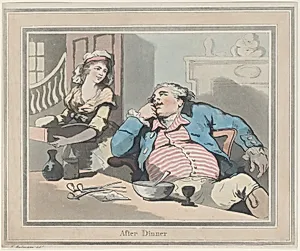
After Dinner
1790?
Medium
Hand-colored etching and aquatint
Dimensions
Sheet: 8 7/16 × 10 1/4 in. (21.5 × 26.1 cm)
Classification
Prints
Department
Drawings and Prints
Museum
Metropolitan Museum of Art, New York, NY
Credit
The Elisha Whittelsey Collection, The Elisha Whittelsey Fund, 1959
Accession Number
59.533.378
Rights
Public Domain
Tags
Art Historical Context
Thomas Rowlandson's *After Dinner* (ca. 1790) captures a lively slice of late Georgian social life through a hand-colored etching and aquatint, a technique that allowed for rich tonal gradations and painterly effects mimicking watercolor washes. Measuring just 8 7/16 × 10 1/4 inches, this intimate print exemplifies Rowlandson's mastery of satirical caricature, a hallmark of British printmaking during the Regency era. Housed in the Metropolitan Museum of Art Elisha Whittelsey Collection, it viewers into a postprandial gathering of men and women, likely poking fun at the excesses of dinner parties and flirtatious banter. Rowlandson, a prolific artist known for his humorous and often risqué depictions of everyday follies, belonged to the vibrant world of 18th-century London caricaturists alongside figures like James Gillray. His works critiqued the upper classes' indulgences, blending sharp social observation with exaggerated features and dynamic compositions. The hand-coloring here adds vivid whimsy, heightening the comedic chaos typical of his output, which was widely disseminated as affordable prints for a broad audience. This piece reflects the cultural zeitgeist of Enlightenment-era Britain, where satire flourished amid rapid urbanization and shifting social norms. *After Dinner* not only entertains but also preserves a witty snapshot of human nature, reminding us how art can skewer polite society with enduring charm.
About the Artist
Thomas Rowlandson · 1756–1827
Thomas Rowlandson (1757–1827) was an English artist and caricaturist whose satirical watercolors and prints captured the social life of Georgian Britain with unparalleled wit and technical mastery. Alongside James Gillray, he is recognized as one of the greatest British graphic artists, and his distinctive flowing line and keen observations have made his work integral to understanding late 18th an...