
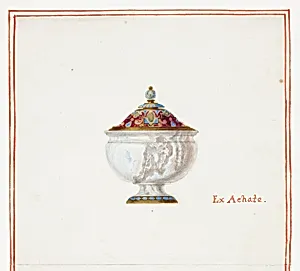
Agate Covered Bowl
n.d.
Medium
Gouache, heightened with touches of gold paint, over black chalk, on ivory laid paper
Dimensions
13.7 × 15 cm (5 7/16 × 5 15/16 in.)
Classification
gouache
Department
Prints and Drawings
Museum
Art Institute of Chicago
Accession Number
115495
Rights
Public Domain
Art Historical Context
Giuseppe Grisoni’s *Agate Covered Bowl* captures the quiet elegance of a luxurious decorative object through the delicate medium of gouache. Executed on smooth ivory laid paper and heightened with touches of gold paint, the drawing renders the swirling natural patterns of agate with remarkable precision and luminosity. At just 13.7 by 15 centimeters, the work invites close viewing, allowing the viewer to appreciate the stone’s banded textures and the subtle gleam of the gold accents that suggest a finely crafted vessel. Gouache, an opaque watercolor, was favored in the eighteenth century for its ability to produce rich, velvety surfaces and fine detail—qualities that make it especially well suited to recording precious objects like carved agate. Grisoni’s technique combines the medium’s density with the soft underdrawing of black chalk, creating both depth and a sense of tangible materiality. Such studies often served as records for collectors or as designs for goldsmiths and lapidaries working in European courts. Housed in the Prints and Drawings department of the Art Institute of Chicago, this small sheet reflects the period’s fascination with natural wonders transformed by human skill. Agate bowls were prized for their rarity and the way their organic patterns seemed to echo the artistry of nature itself, making Grisoni’s rendering both a technical achievement and a celebration of refined taste.
About the Artist
Giuseppe Grisoni · 1699–1769
Giuseppe Grisoni was born in Mons, in the Spanish Netherlands, in 1699, to an Italian family, and his career unfolded across multiple European courts and cultural centers, making him a quintessentially cosmopolitan figure of the early eighteenth century. He received his artistic training in Florence, where he absorbed the rich tradition of Florentine portraiture and absorbed the influence of the G...