
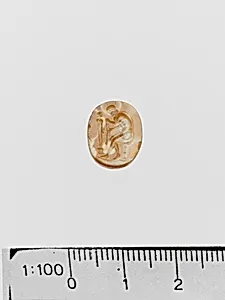
Agate ring stone
Unknown Artist
3rd–2nd century BCE
Medium
Agate
Dimensions
Length: 1/2 in. (1.3 cm)
Classification
Gems
Culture & Period
Italic · Hellenistic
Department
Greek and Roman Art
Museum
Metropolitan Museum of Art, New York, NY
Credit
Gift of John Taylor Johnston, 1881
Accession Number
81.6.26
Rights
Public Domain
Tags
Art Historical Context
This exquisite agate ring stone, carved the 3rd–2nd century BCE, hails from Italic culture during the Hellenistic period—a time when Greek artistic influences blended with local Italian traditions following Alexander the Great's conquest. Measuring just 1/2 inch (1.3 cm) long, this tiny gem was likely designed as an intaglio for a signet ring, used to imprint wax seals or as personal jewelry. Its subject, men engaged in labor, captures a rare glimpse of everyday working life, a motif less common than mythological scenes in ancient gems. Crafted from durable agate, a favored medium for its translucency and hardness, the stone showcases the remarkable precision of Hellenistic engravers. Using fine metal tools and abrasives, artisans achieved intricate details on such a minuscule scale, highlighting technical virtuosity. These gems were status symbols for the elite, blending utility with artistry. Now housed in the Metropolitan Museum of Art's Greek and Roman Art Department—thanks to a gift from John Taylor Johnston in 1881—this piece invites us to ponder the unsung workers of antiquity, reminding us that even the smallest artifacts reveal profound cultural stories.