
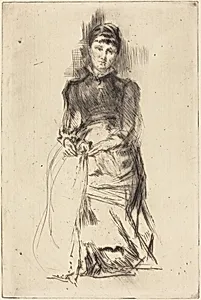
Agnes
c. 1873/1875
Medium
drypoint on laid paper
Classification
Department
CG-W
Museum
National Gallery of Art, Washington, D.C.
Credit
Rosenwald Collection
Accession Number
1949.5.542
Rights
Public Domain
Art Historical Context
James McNeill Whistler’s drypoint *Agnes*, created around 1873–1875, exemplifies the artist’s masterful command of printmaking during his most productive years in London. An American-born painter and etcher who spent much of his career in Britain, Whistler was a leading figure in the Aesthetic Movement, championing the idea of “art for art’s sake.” This intimate portrait print reveals his fascination with subtle tonal effects and refined line work, qualities that made his prints highly sought after by collectors in the late nineteenth century. Printed on laid paper using the drypoint technique, the work carries the characteristic soft, velvety burr that results when the artist’s needle raises delicate metal shavings along each line. Unlike etching, drypoint allows for rich, atmospheric textures that Whistler exploited to suggest form and mood with remarkable economy. The Rosenwald Collection’s impression at the National Gallery of Art preserves these fine details, offering viewers a direct connection to Whistler’s hand and his innovative approach to the medium. As part of Whistler’s extensive body of graphic work, *Agnes* reflects the growing appreciation for prints as independent works of art rather than mere reproductions. Its restrained elegance and technical sophistication continue to highlight Whistler’s lasting influence on modern printmaking.
About the Artist
James McNeill Whistler · 1834–1903
James Abbott McNeill Whistler (1834-1903) was an American-born painter and printmaker who became a leading figure in the Aesthetic Movement and pioneer of Tonalism and Japonisme. He revolutionized art by championing "art for art's sake" and treating paintings as visual equivalents of musical compositions, titling works as "arrangements," "harmonies," and "nocturnes" to emphasize formal qualities o...