
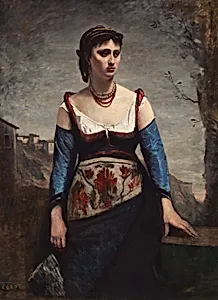
Agostina
Medium
oil on canvas
Dimensions
overall: 132.4 x 97.6 cm (52 1/8 x 38 7/16 in.) framed: 173.7 x 138.4 cm (68 3/8 x 54 1/2 in.)
Classification
Painting
Department
CF
Museum
National Gallery of Art, Washington, D.C.
Credit
Chester Dale Collection
Accession Number
1963.10.108
Rights
Public Domain
Art Historical Context
Jean-Baptiste-Camille Corot's *Agostina* (1866) is a captivating oil-on-canvas portrait that exemplifies the artist's mastery in his later years. Measuring 132.4 x 97.6 cm, this large-scale work captures a young woman—likely the Italian model Agostina Segatori—in a moment of quiet introspection, gazing thoughtfully into the distance. Corot, a leading figure of the Barbizon School and a bridge between Romanticism and Impressionism, painted this during a period when he increasingly focused on luminous portraits alongside his renowned landscapes. The painting's artistic significance lies in Corot's innovative technique: loose, fluid brushwork creates a soft, atmospheric glow, blurring the edges of forms to evoke emotion and depth. This approach influenced younger artists like the Impressionists, who admired his ability to infuse realism with poetic light. Oil on canvas allowed Corot to layer subtle glazes, achieving the velvety textures and subtle tonal shifts that make *Agostina* feel alive and intimate. Housed in the National Gallery of Art as part of the esteemed Chester Dale Collection, this piece offers visitors a glimpse into 19th-century French portraiture's evolution. Its monumental presence invites contemplation, reminding us of Corot's enduring legacy in blending observation with imagination.
About the Artist
Jean-Baptiste-Camille Corot · 1796–1875
Jean-Baptiste-Camille Corot, born on July 16, 1796, in Paris to a prosperous bourgeois family—his father a former wig-maker turned draper and his mother a successful milliner—was initially apprenticed in the textile trade but pursued art from his mid-twenties with family support. He studied under the neoclassical landscapist Achille Etna Michallon in 1821–1822, who taught him to sketch outdoors in...