
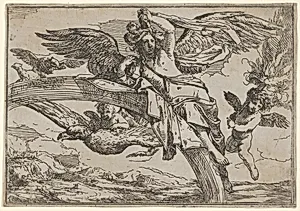
Air, represented by Iris reclining on her rainbow, accompanied by a winged putto bearing a torch and another winged putto riding an eagle, from "The Elements"
Giulio Carpioni, 1640–60
About this artwork
In the mid-17th century, Italian artist Giulio Carpioni crafted this enchanting etching, *Air, represented by Iris reclining her rainbow, accompanied by winged putto bearing a and another winged putto riding an eagle*, as part of his series *The Elements*. Active during the Baroque era (1640–60), Carpioni drew from Venetian and Bolognese, specializing in intricate small-scale works that blended mythological allegory with playful fantasy. This print, now in the Metropolitan Museum of Art's Drawings and Prints collection, exemplifies the period's fascination with the classical elements—earth, air, fire, and water—as symbols of the natural world. The composition vividly personifies "Air" through Iris, the Greek goddess of the rainbow and divine messenger, lounging gracefully on her luminous arc. Flanking her are two cherubic putti: one brandishes a torch evoking ethereal light, while the other rides a majestic eagle, soaring emblem of the skies. These whimsical figures infuse the scene with movement and joy, reflecting Baroque ideals of dynamism and grandeur in miniature form. Etching allowed Carpioni to achieve fine, expressive lines on a modest 4 5/16 × 6 1/8 in. sheet, making such elaborate allegories accessible to collectors. Bequeathed by Phyllis Massar in 2011, this work highlights the cultural role of prints in disseminating mythological themes, bridging elite art with broader audiences during Europe's Age of Exploration and scientific wonder.