
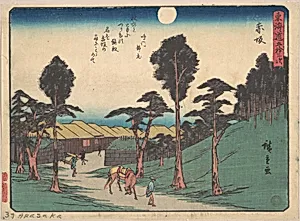
東海道五十三次 赤坂|Akasaka
ca. 1838
Medium
Woodblock print; ink and color on paper
Dimensions
8 1/2 x 6 1/2 in. (21.6 x 16.5 cm)
Classification
Prints
Culture & Period
Japan · Edo period (1615–1868)
Department
Asian Art
Museum
Metropolitan Museum of Art, New York, NY
Credit
Rogers Fund, 1914
Accession Number
JP93
Rights
Public Domain
Tags
Art Historical Context
Utagawa Hiroshige *Akasaka*, from his renowned series *The Fifty- Stations of the Tōidō* (ca. 1838), captures essence of travel along Japan's historic coastal highway connecting Edo (modern Tokyo) Kyoto during the Edo period1615–1868). This woodblock print depicts the Akasaka station, of 53 official post stations where travelers, changed horses, and navigated the landscape. Hiroshige, a master of the ukiyo-e ("pictures of the floating world"), immortalized everyday scenes of pilgrimage and commerce, making art accessible to the masses through affordable prints. In this intimate 8½ × 6½-inch composition, Hiroshige employs his signature atmospheric style: a luminous full moon bathes houses, trees, and winding paths in soft glows, while human figures and horses evoke the quiet drama of night travel. The woodblock technique—layered ink and color on paper—allowed for vibrant blues, greens, and subtle gradients, showcasing the collaborative precision of Edo-era artisans who carved and printed in editions for widespread distribution. Culturally, the Tōkaidō series celebrated Japan's interconnected roads and transient beauty, influencing global art from Impressionism to van Gogh. Acquired via the Rogers Fund in 1914, this Metropolitan Museum gem invites visitors to ponder the poetry of journey in pre-modern Japan.
About the Artist
Utagawa Hiroshige · 1826–1869
Utagawa Hiroshige (1797–1858), born Andō Tokutarō, was the last great master of Japanese ukiyo-e woodblock printmaking and one of the most influential landscape artists in history. Born in Edo (modern Tokyo) into a low-ranking samurai family serving as fire wardens, Hiroshige transformed landscape printmaking into a poetic meditation on nature, weather, and everyday life. His revolutionary approac...