
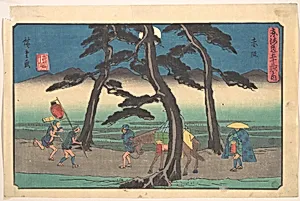
東海道五十三次之内 赤阪|Akasaka Station
ca. 1842
Medium
Woodblock print; ink and color on paper
Dimensions
8 27/32 x 13 1/2 in. (22.5 x 34.3 cm)
Classification
Prints
Culture & Period
Japan · Edo period (1615–1868)
Department
Asian Art
Museum
Metropolitan Museum of Art, New York, NY
Credit
Purchase, Joseph Pulitzer Bequest, 1918
Accession Number
JP572
Rights
Public Domain
Tags
Art Historical Context
Utagawa Hiroshige *Akasaka Station* (ca. 1842) is a vibrant woodblock print from his series *The Fifty-three of the Tōkaidō*, which captures the 53 post stations along the historic coastal road connecting Edo (modern Tokyo) Kyoto during Japan's Edo period (16151868). This vital route was a lifeline for travelers, merchants, and officials under the shogunate's travel restrictions, and Hiroshige's depictions romanticized the journey's landscapes, weather, and human activity, making ukiyo-e landscapes hugely popular. In this print, measuring about 8½ by 13½ inches, Hiroshige masterfully renders men, horses, rolling hills, and trees with ink and color on paper—a technique involving collaborative carving and printing by artisans. The dynamic composition highlights the rugged terrain around Akasaka station, evoking the perils and beauty of travel. Hiroshige's subtle use of color gradients and atmospheric perspective brought a poetic realism to woodblock prints, influencing global artists like Vincent van Gogh. Housed in the Metropolitan Museum of Art's Asian Art Department (purchased via the Joseph Pulitzer Bequest in 1918), this work exemplifies Edo-era cultural fascination with *fūkei-ga* (landscape prints) and the transient beauty of life, offering visitors a window into Japan's pre-modern world.
About the Artist
Utagawa Hiroshige · 1826–1869
Utagawa Hiroshige (1797–1858), born Andō Tokutarō, was the last great master of Japanese ukiyo-e woodblock printmaking and one of the most influential landscape artists in history. Born in Edo (modern Tokyo) into a low-ranking samurai family serving as fire wardens, Hiroshige transformed landscape printmaking into a poetic meditation on nature, weather, and everyday life. His revolutionary approac...