
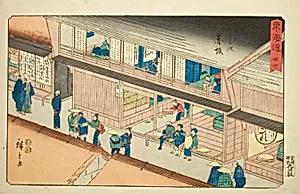
Akasaka—No. 37, from the series "Fifty-three Stations of the Tokaido (Tokaido gojusan tsugi)," also known as the Reisho Tokaido
c. 1847/52
Medium
Color woodblock print; oban
Dimensions
25.5 × 38 cm (10 1/16 × 14 15/16 in.)
Classification
woodblock print
Department
Arts of Asia
Museum
Art Institute of Chicago
Accession Number
18314
Rights
Public Domain
Art Historical Context
Utagawa Hiroshige *Akasaka—No. 37* from the series *Fifty Stations of the Tōkaidō (Tōkaidō gojūsan tsugi)*, also known as the Reo Tōkaidō, captures the essence of travel along Japan's historic coastal highway during the Edo period (1603–1868). around 1847–52 as a color woodblock print in the large oban format (25.5 × 38 cm), this work is part of Hiroshige's series depicting the 53 post stations between Edo (modern Tokyo) and Kyoto. The Tōkaidō road was a vital artery for pilgrims, merchants, and samurai, symbolizing mobility and cultural exchange in feudal Japan. Hiroshige, a master of the ukiyo-e ("pictures of the floating world") school, elevated landscape prints with his atmospheric depictions of nature and daily life. In the Reisho edition, bold reisho calligraphy titles add a dynamic flair. Woodblock printing techniques—carving intricate blocks for each color layer—allowed mass production, making these prints affordable souvenirs that democratized art. Akasaka Station, perched in the mountains, likely evokes the road's rugged beauty and travelers' perseverance. Housed in the Art Institute of Chicago's Arts of Asia department, this print exemplifies Hiroshige's influence on global art, inspiring Impressionists like Monet and Van Gogh. It invites visitors to ponder Japan's poetic fusion of journey and scenery.
About the Artist
Utagawa Hiroshige · 1826–1869
Utagawa Hiroshige (1797–1858), born Andō Tokutarō, was the last great master of Japanese ukiyo-e woodblock printmaking and one of the most influential landscape artists in history. Born in Edo (modern Tokyo) into a low-ranking samurai family serving as fire wardens, Hiroshige transformed landscape printmaking into a poetic meditation on nature, weather, and everyday life. His revolutionary approac...